Best crypto card for crypto wealth management

What if your daily coffee purchase could help you accumulate more Bitcoin? The right crypto card transforms ordinary spending into a strategic wealth-building tool.
This guide evaluates top contenders—UUPAY, Nexo, and Crypto.com—across rewards, fees, security, and usability. You will leave with a clear, data-driven recommendation for your financial goals. Finding the Best crypto card requires matching features to your priorities.
Key Takeaways
Match your crypto card to your spending habits and wealth goals. High spenders should prioritize cashback. Long-term holders should choose cards that let them borrow without selling.
Borrowing against your crypto avoids taxable events. This strategy keeps your portfolio intact while you access spending power. It is a smart move for long-term investors.
Always calculate the total cost of a card. Look beyond cashback rates. Consider fees, limits, and hidden costs. A low-fee card often delivers better net value.
Top Crypto Cards for Wealth Growth
Selecting the Best crypto card means matching your spending habits to the right rewards engine. Three cards lead the market, each with a distinct wealth-building strategy. UUPAY offers a balanced, low-cost entry point. Nexo lets you borrow against your crypto without selling. Crypto.com delivers high cashback with a significant lockup commitment.
UUPAY Card: The All-Rounder
UUPAY positions itself as the accessible choice for everyday crypto spending. You pay zero fees on card top-ups. New users receive a virtual card for just 1 USDT, and the platform refunds that fee immediately. This low barrier makes UUPAY attractive for anyone starting their crypto wealth journey.
Compliance strengthens UUPAY's appeal. The company holds a US MSB license and operates under Hong Kong regulations. It also maintains PCI DSS Level 1 certification. A Swiss entity and a pending Brazilian license add further credibility. You can spend your crypto globally with 24/7 support.
Unlike Crypto.com, which requires a $5,000 CRO stake to unlock 4.5% cashback, UUPAY delivers strong usability without a capital lockup. You retain full control of your assets while earning rewards on everyday purchases. For wealth management, this means your crypto works for you without being tied up.
How Crypto Cards Work
Crypto cards come in two main types. Each type handles funding and spending differently. Understanding these mechanics helps you choose the Best crypto card for your wealth strategy.
Debit vs. Credit Mechanics
A prepaid crypto debit card connects directly to your crypto balance. When you tap or swipe at a merchant's POS terminal, the card issuer sells your crypto instantly. The platform calculates the exact amount of crypto needed to cover the fiat amount. It applies a real-time exchange rate plus a small spread. The crypto sells on the exchange's internal liquidity system, converting it to the required fiat equivalent. An approval sends back through the payment network to the merchant. The entire transaction completes in seconds. The merchant receives local currency and never knows crypto funded the purchase.
A crypto credit card works differently. Instead of selling your assets, it borrows fiat currency from the issuer. Your crypto serves as collateral. You repay the loan later.
The table below shows the key differences:
Aspect | Prepaid Crypto Debit Card | Crypto Credit Card |
|---|---|---|
Funding Source | Connects to existing crypto balance; funds are debited immediately | Borrows fiat currency from the issuer; crypto is used only as collateral |
Spending Limit | Equal to the amount held in your wallet | Based on approved credit line or collateral value |
Transaction Mechanism | Crypto is sold automatically at point of sale | Fiat is lent to pay the merchant; you repay later |
The card issuer maintains a pre-funded fiat float with the processor. At the moment of sale, the fiat advances from this float instantly. The merchant receives payment without waiting for the crypto sale. The exchange offsets the float by converting your crypto on its internal liquidity pools. This backend process remains invisible to you.
Spending Crypto Without Selling
The Nexo card offers a unique model. It avoids selling your crypto entirely. When you make a purchase, the card deducts the amount from your available credit line. Your crypto collateral secures that line.
Borrowing against crypto does not trigger capital-gains tax, whereas selling does. The Nexo card leverages this principle. You borrow fiat against your collateral. Your crypto portfolio stays intact. You avoid any taxable disposal event.
This makes the card ideal for long-term holders. You need occasional spending power without breaking your strategy. Using crypto as collateral and never selling the tokens means no taxable event occurs. Your wealth continues growing while you spend.
Key Factors for Choosing a Card
Selecting the Best crypto card requires more than comparing flashy cashback percentages. You must evaluate the complete cost structure and reward mechanics. A card that offers 4.5% cashback but charges high fees may deliver less value than a modest-reward card with no hidden costs.
Rewards and Cashback Structures
Cashback rates vary dramatically across providers. Crypto.com offers up to 4.5% back, while some competitors like Oobit advertise 10% on certain purchases. You must examine what currency you receive. Stablecoin cashback, such as mUSD, provides predictable value. Volatile token-based rewards can lose worth before you spend them.
Consider the effective net return after accounting for all costs. Industry analysis shows net rewards typically range from 0.8% to 3% once you factor in FX spreads, ATM fees, and subscription charges. A high headline rate often masks a lower real yield. You should model your own spending patterns to calculate actual returns.
Fees, Limits, and Hidden Costs
Fee structures differ substantially between leading cards. The table below compares key costs:
Card | ATM fee | FX fee | Monthly fee |
|---|---|---|---|
Crypto.com Visa | $2–$4.50 over monthly cap | 0% (mid-market FX) | $0 |
Nexo Card | Free up to limit, then 2% | 0% | $0 |
Crypto.com provides mid-market exchange rates with no markup. ATM withdrawals remain free up to a monthly cap that scales with your card tier. Exceeding that cap costs $2–$4.50 per withdrawal. Nexo charges no FX fees and offers free ATM withdrawals up to a loyalty-tier-based limit, after which a 2% fee applies. Neither card carries a monthly fee.
You must also examine foreign transaction fees. Some providers, like KAST, charge 2% on non-USD purchases. Others impose 5% local and 10% international ATM withdrawal fees. These costs erode your wealth silently. Always calculate your total cost of ownership before committing to a card.
Security and Asset Protection
Your crypto wealth deserves robust protection. The Best crypto card combines strong security features with smart tax planning. You need both layers to preserve your portfolio.
Essential Security Features
Two-factor authentication (2FA) stands as your first line of defense. You should enable it immediately after card activation. This adds a second verification step beyond your password. Most providers support authenticator apps rather than SMS codes. Authenticator apps offer stronger protection against SIM-swapping attacks.
Cold storage integration protects your underlying assets. Top-tier card providers keep the majority of crypto in offline wallets. Only a small operational reserve stays online for transaction processing. This separation minimizes exposure to exchange hacks. You should verify your provider's storage practices before depositing large amounts.
FDIC insurance applies only to fiat balances, not crypto holdings. Some providers hold your US dollars in partner banks with FDIC coverage. This protects up to $250,000 per depositor. Your crypto tokens remain uninsured. You must understand this distinction clearly. The insurance protects the cash equivalent, not the digital assets themselves.
Mitigating Volatility and Tax Risks
Borrowing against your crypto avoids triggering a taxable event. When you sell crypto, you realize capital gains. When you borrow, no sale occurs. The Nexo card exemplifies this strategy. You use your holdings as collateral for a fiat loan. Your portfolio remains untouched. You defer taxes until you actually sell.
Borrowing against crypto is generally tax-free because no sale occurs
This means no capital gains tax triggers at the moment of borrowing
Your original assets stay intact while you access spending power
Tracking transactions remains essential for accurate reporting. Crypto tax software like CoinLedger helps you monitor every trade and purchase. These tools identify tax-saving opportunities automatically. They generate reports your accountant can use directly. You should connect your card transactions to such software from day one.
Market volatility poses liquidation risks. If your collateral value drops below the required loan-to-value ratio, the provider may liquidate your position. You should maintain a conservative LTV ratio. Monitor your collateral regularly. Set alerts for significant price movements. This vigilance protects your wealth from forced sales during market downturns.
Detailed Reviews of Top Cards
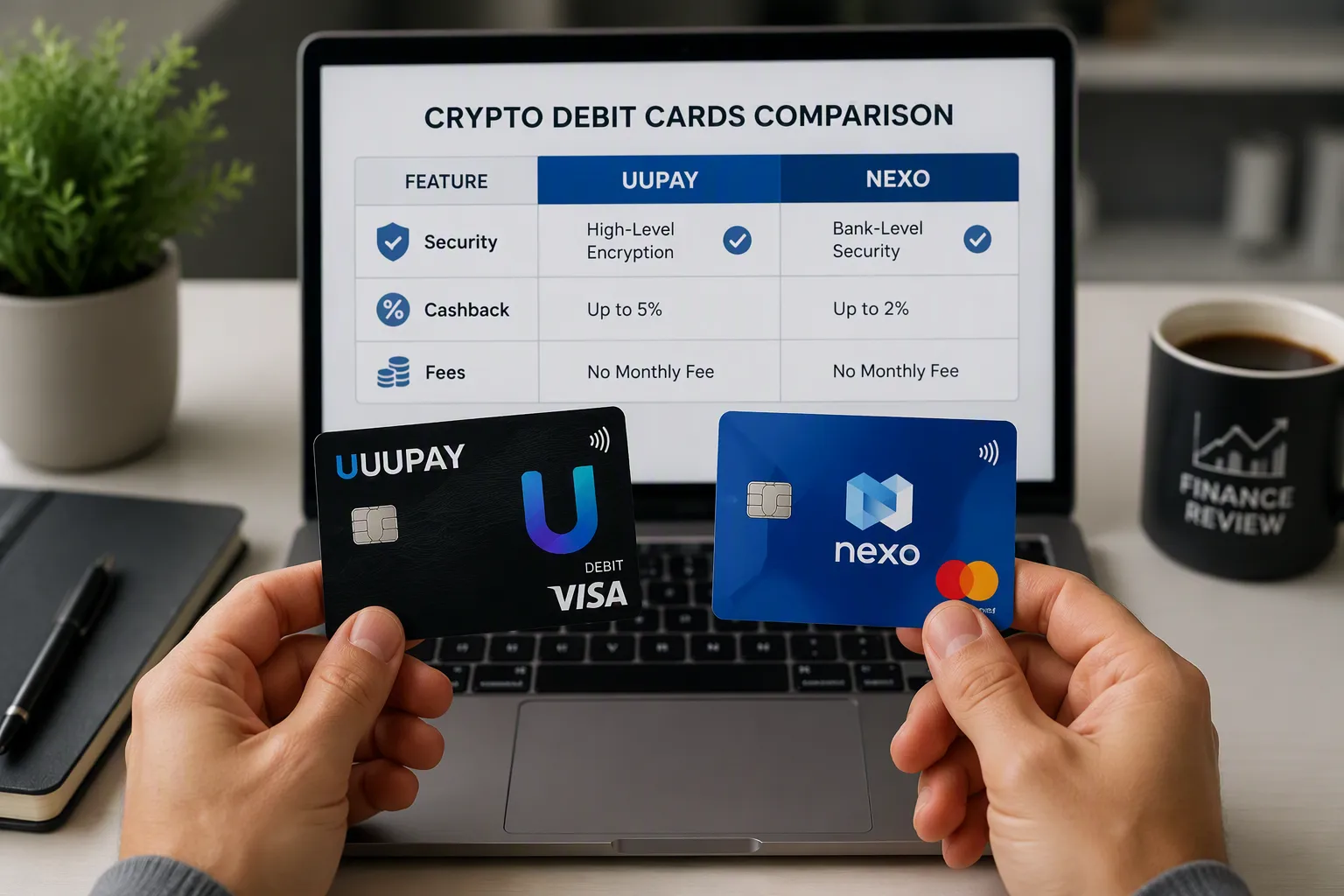
Understanding each card's strengths helps you identify the Best crypto card for your wealth strategy. Below you will find balanced reviews of the UUPAY and Nexo cards. Each review covers pros, cons, and the ideal user profile.
UUPAY Card Review
UUPAY offers a compelling entry point for new crypto users. You receive a virtual card for just 1 USDT, and the platform refunds that fee immediately. This gives you a free start. You also pay zero fees on card top-ups. Your entire deposit reaches your spending balance without deductions.
Compliance sets UUPAY apart from many competitors. The company holds a US MSB license and operates under Hong Kong regulations. It maintains PCI DSS Level 1 certification for payment security. A Swiss entity adds European credibility, and a Brazilian license is pending approval. You also get 24/7 global support. This compliance checklist — US MSB Licensed, PCIDSS Level 1 Certified, 24/7 Global Support — signals strong reliability.
The referral program offers up to 50% commission. You earn substantial rewards by inviting others. Cashback reaches up to 5% on purchases. Annual fees stay at just $1. Transaction and withdrawal fees remain low compared to industry averages.
Pros: Strong compliance and security; free virtual card for new users; zero top-up fees; high referral commission; seamless integration with Touch 'n Go and DuitNow for Malaysian users; 24/7 customer support.
Cons: Limited expansion outside Malaysia and Southeast Asia; physical card availability may be restricted in some regions.
Ideal user: You want a low-cost, compliant card for everyday spending in Southeast Asia. You value strong security and straightforward rewards without capital lockups.
Nexo Card Review
Nexo takes a different approach to crypto spending. You can use it as a debit card or a credit card. In credit mode, you borrow against your crypto without selling. This avoids taxable events. Your portfolio stays intact while you access liquidity.
The card carries no annual fees. Cashback reaches up to 2% in NEXO tokens or 0.5% in Bitcoin, depending on your loyalty tier. You earn these rewards only in credit mode. You must meet loyalty thresholds to unlock the best rates.
Borrowing rates start at 1.9% per year for Platinum-tier clients with a loan-to-value ratio of 20% or lower. Your rate depends on your NEXO token holdings and chosen LTV. The credit line has no maturity date and no fixed repayment schedule. You repay any amount at any time. Interest accrues daily only on the outstanding balance.
Liquidation risk exists. The system monitors your LTV in real time. Automatic collateral liquidation triggers if your LTV approaches 83.33%. You should maintain a conservative LTV ratio to protect your assets. For long-term holders, this approach makes Nexo the Best crypto card for tax-efficient spending.
Pros: Dual-mode functionality; no annual fees; cashback up to 2% in NEXO or 0.5% in BTC; no need to sell crypto; flexible credit line with no fixed repayment schedule.
Cons: Limited availability to Europe (EEA and UK); cashback only in credit mode with loyalty thresholds; foreign exchange fees and ATM costs apply; requires crypto collateral; interest charged if balance not repaid.
Ideal user: You are a long-term crypto holder in Europe. You want to access spending power without triggering capital gains tax. You maintain a conservative LTV ratio and monitor your collateral regularly.
How to Choose the Best Crypto Card

Selecting the right card demands a clear-eyed assessment of your spending patterns and wealth objectives. No single option works for everyone. Your choice hinges on how you spend, what you hold, and where you live.
Aligning Card Features with Goals
Start by mapping your spending habits against card features. High-volume spenders should prioritize cashback rates above all else. Long-term holders benefit more from borrowing features that preserve their portfolio. Match the card to your dominant behavior.
Consider these selection criteria before committing:
Reward rate: Compare flat-rate rewards (e.g., 2% on all spending) against category-based rewards (e.g., 3% on dining) to match your spending habits.
Annual fee: Prioritize $0-fee cards unless your spending volume justifies a paid tier's break-even point.
Card type: Choose between a credit card (builds credit), a debit card (no credit check), or a crypto-backed card (collateral-based) based on your financial profile.
Self-custody eligibility: If you want to withdraw BTC to your own wallet, select a card that explicitly supports this feature.
Issuer standing: Prefer regulated and established issuers for security and reliability.
Geographic availability: Verify that the card is offered in your country or region, as most are US-only, with limited options for European or EEA residents.
High-volume spenders face a different calculus. The table below shows how tiered plans scale with monthly activity:
Plan | Monthly Spending Cap | Cashback Rate | Purchase Rebates |
|---|---|---|---|
Private (Icy/Rose/Obsidian) | Unlimited | Up to 5% (6.5% in first year for Obsidian) | Unlimited (Spotify, Netflix, Truth+) |
Pro (Jade/Indigo) | $2,500 | 3% (after first year) | 6 months |
Plus (Ruby) | $1,250 | 2% | 3 months |
If you spend more than $2,500 monthly, the Private tier justifies its staking requirement. Below that threshold, the Pro plan delivers better value without the capital lockup.
Integrating the Card into Your Strategy
A crypto card works best as part of a broader wealth management system. You should automate your rewards to compound growth rather than letting them sit idle.
DCA-style investing by earning crypto on everyday purchases spreads risk and helps benefit from market dips. This approach proves most effective during uncertain markets or early in a market cycle when prices stabilize. Conversely, during market peaks, you risk buying at higher prices and facing a downturn. Timing purchases based on market cycles becomes a critical advanced strategy.
Optimize your reward categories by aligning spending with specific cashback multipliers. Use different cards for different categories—travel, groceries, dining—to significantly increase monthly crypto earnings. Automatically convert cashback into stablecoins or blue-chip assets to build a balanced portfolio over time. This ensures rewards contribute to long-term goals rather than remaining idle.
Security practices matter equally. Enable biometrics or 2FA, store only necessary spending funds in the card wallet, and keep bulk assets in cold storage. Freeze lost virtual cards promptly to reduce risk.
Tax compliance requires attention. Crypto spending often counts as a disposal of assets. Use compliance automation tools and APIs to track cost basis for hundreds of small transactions. This prevents penalties and keeps your records clean.
For new users, UUPAY offers a practical entry point. The virtual card costs just 1 USDT, and the platform refunds that fee immediately. Card top-ups carry zero fees. The platform holds a US MSB license, PCI DSS Level 1 certification, and operates under Hong Kong regulations. A Swiss entity and pending Brazilian license add further credibility. You also earn up to 50% commission through referrals.
The Best crypto card aligns with your specific financial situation. Match the features to your goals, automate your rewards, and maintain disciplined security practices.
Potential Risks and Pitfalls
Market Volatility and Liquidation Risks
Borrowing against your crypto creates a dangerous exposure to market swings. The Nexo card monitors your loan-to-value ratio in real time. When your collateral value drops, your LTV rises. The system triggers automatic liquidation when your LTV approaches 83.33%. You lose your collateral at the worst possible moment.
Consider a concrete scenario. You borrow against Bitcoin at a 50% LTV. Bitcoin drops 40% in a week. Your LTV spikes above the liquidation threshold. The platform sells your Bitcoin to cover the loan. You lose your assets and your position. This scenario happens regularly during market corrections.
You must maintain a conservative LTV ratio. Keep it below 30% for volatile assets. Monitor your collateral daily. Set price alerts for significant movements. The borrowing rate also escalates with risk. Entry-tier borrowers pay up to 17.9% interest. Top-tier clients pay as little as 0.9%. Your tier depends on your loyalty level and chosen LTV.
Avoiding Common User Errors
Overspending with a crypto credit card creates a debt spiral. You borrow against your portfolio for everyday purchases. Interest accrues daily on the outstanding balance. The penalty rate reaches 18.9% if you repay within 45 days. This fee structure punishes short-term borrowing.
Tax tracking presents another challenge. Every crypto transaction counts as a disposal for tax purposes. You must record the cost basis for each purchase. Hundreds of small transactions create a complex reporting burden. Use crypto tax software from day one. Connect your card transactions automatically. This prevents penalties and keeps your records clean.
The Best crypto card protects your wealth only when you use it responsibly. Set a monthly spending limit. Repay borrowed amounts quickly. Track every transaction for tax reporting. These habits prevent small errors from becoming costly mistakes.
The Best crypto card depends on your priorities. UUPAY offers a strong balance. Nexo suits long-term holders. Crypto.com rewards high-volume spenders. Revisit the reviews and comparison table above. Match each card's strengths to your financial situation. As crypto cards evolve, they become indispensable tools for integrating digital assets into daily life and long-term wealth strategy.
FAQ
Finding the Best crypto card raises several common questions. Here are answers to the most frequent ones.
What makes UUPAY's new user offer attractive?
You receive a virtual card for just 1 USDT. The platform refunds that fee immediately. Card top-ups carry zero fees. Your entire deposit reaches your spending balance.
How does UUPAY ensure regulatory compliance?
UUPAY holds a US MSB license and PCI DSS Level 1 certification. The company operates under Hong Kong regulations. A Swiss entity and pending Brazilian license add credibility.
Can I earn passive income through crypto card referrals?
Yes. UUPAY's referral program offers up to 50% commission. The more friends you invite, the higher your rebate tier climbs.
See Also
A Step-By-Step Guide To Obtaining Your Own Crypto Card
Top Virtual Crypto Cards: A Detailed Comparison Of Features And Perks
Evaluating Top Crypto Cards For Daily Purchases And Transactions
Top Prepaid Crypto Cards For Convenient Daily Use And Spending
UUPAY's Comprehensive Guide To Multi-Currency Crypto Cards For The Unbanked
