Best eSIM for Vietnam Travel: Skip Expensive Roaming
You get home from Vietnam, check your phone bill, and your jaw drops. Those roaming charges really sting. An eSIM fixes that fast. Top picks for the best eSIM for Vietnam Travel include UUPAY, Holafly, Airalo, Saily, Nomad, and Ubigi. Compare prices, coverage, and setup before you fly, so you never overpay again.
Key Takeaways
An eSIM saves you money on roaming charges and connects you instantly in Vietnam.
Choose an eSIM provider based on your data needs and trip length for the best value.
Install your eSIM before you travel to avoid airport hassles and ensure a smooth start.
About the Author
Will is a senior Web3 payments specialist and SEO Content Lead at UUPAY. He has extensive experience in the global decentralized finance (DeFi) and payments ecosystem, with a focus on developing seamless crypto-to-fiat retail payment solutions. Will regularly analyzes digital wallet integrations, international compliance frameworks, and virtual card payment optimization, with the goal of providing users worldwide with secure, simple, and borderless payment guidance.
Why eSIM Beats Roaming in Vietnam
What Is an eSIM
An eSIM is a digital SIM embedded right into your phone's hardware. You cannot remove it or lose it. Instead of a plastic card, you download a profile through a QR code or an app. That means no tiny tray tool, no fumbling at the airport, and no risk of scratching a fragile chip.
The difference from a physical SIM goes beyond convenience. A physical card can be damaged, lost, or stolen. An eSIM stays soldered in and password-protected, so a thief cannot pull it out to disable your tracking. You can also store several profiles at once and switch carriers through software in seconds. Physical SIMs typically hold one active profile and require a manual swap.
Key Benefits for Vietnam Travelers
You skip roaming fees entirely when you use a local eSIM plan. Your home carrier's daily roaming pass can cost far more than a prepaid data package. With an eSIM, you pay local rates instead.
Activation takes minutes. You buy the plan online, receive a QR code, and install it before you fly. Once you land in Vietnam, you turn it on and you are connected. No airport queue, no passport paperwork, no language barrier at a SIM counter.
Your home number stays active for calls and texts on your primary line. Remote workers and families back home can still reach you. You avoid the hassle of finding a local vendor, and you dodge the documentation rules that Vietnam requires for physical SIM registration.
This is why so many travelers now search for the best eSIM for Vietnam Travel before their trip. The setup is simple, the savings are real, and your phone stays secure.
Best eSIM for Vietnam Travel: Top Picks
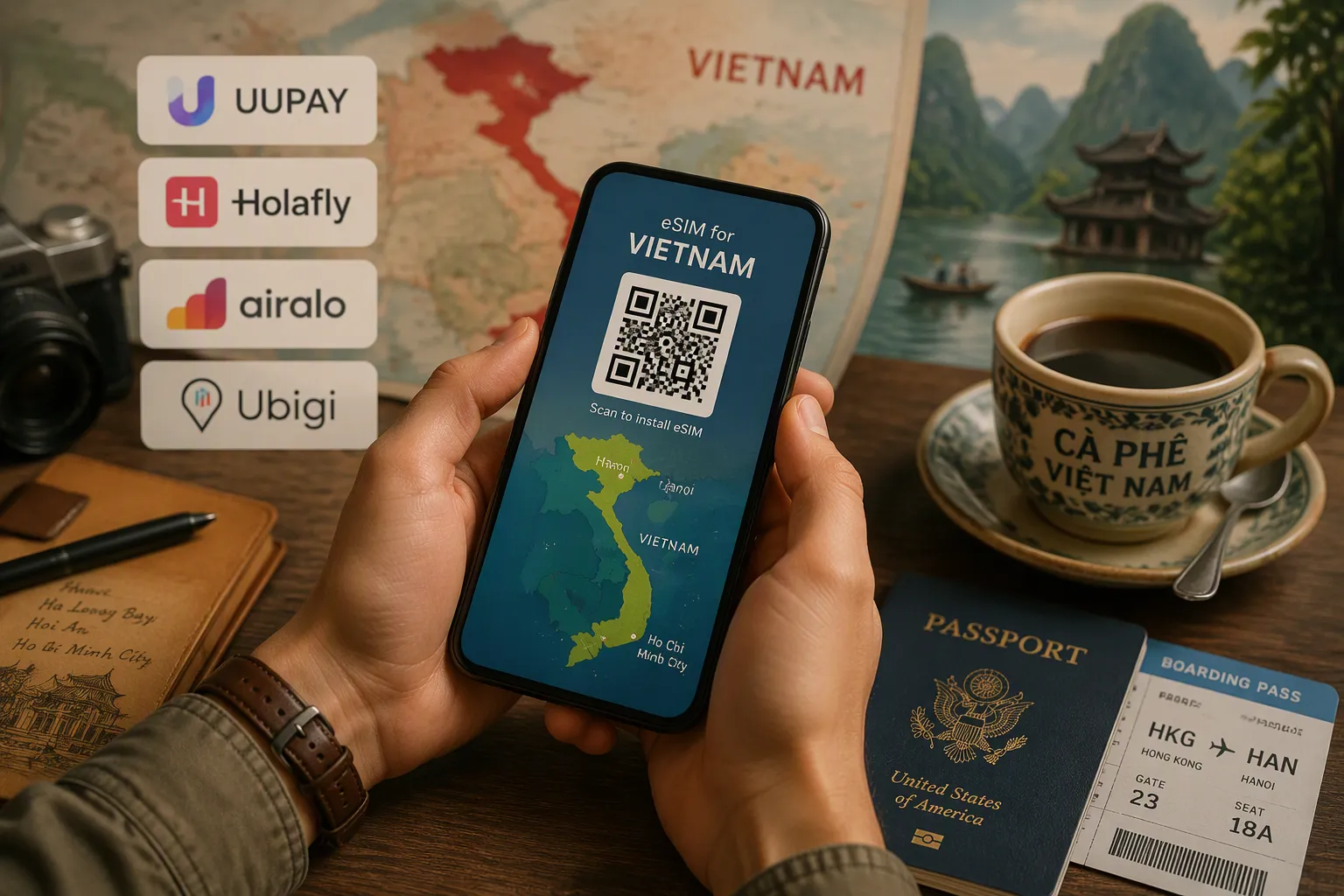
Ask ten travelers for the best eSIM for Vietnam Travel and you will get ten answers. Reddit threads and Facebook groups fill up with fierce debates. One user reported paying about USD 5 for 5 GB over 15 days in Vietnam. Another praised Gohub for fast, human support. Opinions shift with trip length, data habits, and budget. So treat any ranking as a starting point, not gospel.
UUPAY — Best Overall Value
UUPAY earns a top spot for three reasons: competitive pricing, reliable coverage, and a setup most people finish in minutes. You buy a plan, scan a QR code, and you are online. New users get an exclusive offer — activate a virtual card for 1U and receive 1U cashback. Card recharge fees are waived for everyone right now. UUPAY also launched a physical card for global spending, with up to 50% rebate and secure, instant transactions. Beyond data, the app bundles hotel and flight booking, eSIM plans, and chat features. Compliance is solid too: a US MSB license, Swiss and Canadian licenses, a pending Brazilian license, and Hong Kong registration. You also get PCIDSS Level 1 status and 24/7 support. The referral program sweetens things further — more invites unlock higher rebate tiers, with up to 50% commission.
Other Top eSIM Providers
Holafly sells unlimited data at 5G and 4G speeds, which suits heavy users and long stays. Airalo, Saily, Nomad, and Ubigi round out the mainstream field, and Ubigi plans start at $6.90. Two budget names deserve attention. eSIMPal is the cheapest option for small data bundles. Simify offers unlimited data with up to 90% savings on roaming.
Provider | Best For | Notes |
|---|---|---|
UUPAY | Overall value | Competitive pricing, easy setup, extra travel services |
Holafly | Heavy data users | Unlimited data at 5G/4G speeds |
Airalo, Saily, Nomad | Mainstream choice | Established apps, varied plan sizes |
Ubigi | Low entry price | Plans from $6.90 |
eSIMPal | Small bundles | Cheapest for light data use |
Simify | Unlimited data | Up to 90% savings on roaming |
Match the provider to your habits. A light user checking maps and messages needs far less data than a remote worker on video calls all day.
Vietnam eSIM Pricing
How Much Do Vietnam eSIMs Cost
Prices vary widely by provider and data allowance. Ubigi plans start at about $6.90 (€5.93) for 3GB over 15 days. Holafly's unlimited plans begin at about $11.90 (€10.23) for 3 days. Airalo offers a 1GB plan for $4.5, while Nomad charges $5 for 1GB over 7 days. eSIMPal remains the cheapest option for small bundles, and Simify claims up to 90% savings on roaming.
Ubigi plans start at about $6.90 (€5.93) for 3GB, and Holafly's unlimited plans from about $11.90 (€10.23) for 3 days.
Heavy data users should compare unlimited plans carefully. Holafly charges $27.50 for 7 days and $50.50 for 15 days of unlimited data. Ubigi's unlimited 7-day plan costs $24.90, and its 30-day unlimited plan runs $54.90. UUPAY sweetens the deal with fee-free card recharge and a new-user offer: activate a virtual card for 1U and get 1U cashback.
Roaming vs. eSIM Cost Comparison
Traditional roaming punishes your wallet. Major UK networks like EE, Vodafone UK, and O2 charge around £6 per day. That adds up to roughly £42 for a week and £84 for two weeks.
An eSIM flips that math. Ubigi's entry-level 3GB plan costs just $6.90 (€5.93), and even unlimited-data plans remain well below typical roaming costs. That makes eSIM far cheaper than roaming for a typical month-long stay. International travel eSIMs run $15–25 for 30 days, often with caps. Prepaid eSIM plans let you control spending and avoid bill shock entirely.
Vietnam Network Coverage and Speed
Major Carriers and Coverage Areas
Vietnam runs on three major carriers: Viettel, Vinaphone, and Mobifone. Each one powers different eSIM plans, so your experience depends on which network your provider uses. Viettel holds the largest nationwide coverage and excels in rural connectivity. Vinaphone delivers strong urban coverage with stable performance. Mobifone offers reliable city coverage and fast data speeds. All three work well for most international visitors.
Local eSIM plans come from Viettel, Vinaphone, and SkyFi, a MobiFone MVNO. These plans use domestic network access instead of roaming. That approach delivers faster speed and better stability. A Viettel eSIM example provides fast, reliable 5G and 4G connectivity with wide coverage. Travelers on business trips and intercity routes benefit most from this setup.
What Speeds to Expect
Holafly and Ubigi both offer fast 4G and 5G coverage nationwide. Viettel became the first operator to commercialize 5G on October 15, 2024. It runs the only fully standalone 5G SA network in the country. Vinaphone launched premium 5G on December 10, 2024. MobiFone followed on June 23, 2025. These rollouts mean faster speeds across more areas every year.
Rural coverage has limits. In remote or mountainous areas, coverage may be weaker, but basic connectivity is usually available. Viettel reaches even remote areas with strong 4G and 5G. Your actual speed depends on your eSIM provider's underlying carrier. Check which network your plan uses before you buy. That single detail shapes your entire experience with the best eSIM for Vietnam Travel.
How to Set Up a Vietnam eSIM
Before You Travel
Start by checking your phone's compatibility. You need an iPhone XS, iPhone XS Max, iPhone XR, or a later model. Your device must also be unlocked. Open Settings, tap General, then tap About. Look for "No SIM Restrictions" next to Carrier Lock. If you see that, your phone is ready for any carrier.
Next, buy your plan. You can purchase from a local Vietnamese carrier or a worldwide service provider. Local carriers may require your passport. Worldwide providers let you buy online before you fly. Either way, you receive a QR code by email. Install the eSIM before departure. This step takes only a few minutes. You avoid airport queues and SIM shop hassles. Finding the best eSIM for Vietnam Travel starts with this simple preparation.
Installation and Activation
Scan the QR code to install the eSIM on your device. Follow the on-screen prompts. Assign a label to the new plan. Set your primary SIM as the default line. Choose the new eSIM plan for cellular data. Turn on "Turn On This Line" for the eSIM. Then enable Data Roaming for that line. This step is critical. Your eSIM will not connect without it.
Activate the eSIM when you arrive in Vietnam. Some plans require a free call to 900 to complete activation. You must activate within 72 hours of issuance, or the eSIM deactivates automatically. Once active, you get mobile data right away. You can also log into partner apps to redeem offers. Manual network selection helps if the eSIM does not connect automatically. Open Settings, tap Cellular, then tap Network Selection. Disable Automatic and pick the supported network.
eSIM Device Compatibility
Compatible Devices
Most modern smartphones support eSIM technology. Apple leads the pack with iPhone XS and later models, including the iPhone 11 through iPhone 17 series. You also get support on iPhone SE (2020) and iPhone SE (2022). Samsung covers Galaxy S20 and later, plus Note 20, Z Fold, and Z Flip lines. Google Pixel 3 and later work too, along with Pixel Fold. Other brands like Huawei, Oppo, Xiaomi, Sony, and Motorola offer select eSIM-ready models.
Brand | |
|---|---|
Apple | iPhone XS and later, iPhone SE (2020/2022), iPad Air (3rd gen+), iPad Pro, iPad Mini (5th gen+) |
Samsung | Galaxy S20 and later, Note 20, Z Fold, Z Flip, A54, A55 5G |
Pixel 3 and later, Pixel Fold | |
Others | Huawei P40, Oppo Find X5, Xiaomi 13, Sony Xperia 10 IV, Motorola Razr 5G |
Watch out for regional limits. iPhones from Mainland China do not support eSIM. Hong Kong and Macao models mostly skip it too, except iPhone XS, iPhone SE 2020, iPhone 12 Mini, and iPhone 13 Mini. Samsung phones sold in Hong Kong and most South Korean models also lack eSIM. Always verify your specific model before buying a plan for the best eSIM for Vietnam Travel.
How to Check Your Phone
Dial *#06# on your phone. If an EID number appears, your device supports eSIM. No EID means no eSIM hardware.
You can also check your settings. On iPhone, open Settings, tap Cellular, then look for Add eSIM. If you see that option, you are good to go. On Android, open Settings, go to Network & internet or Connections, and search for Add eSIM or Download eSIM. Some Android models have the hardware but carriers or regions disable the feature. Confirm with your manufacturer or carrier if you are unsure.
Tips for Choosing a Vietnam eSIM
What to Look For
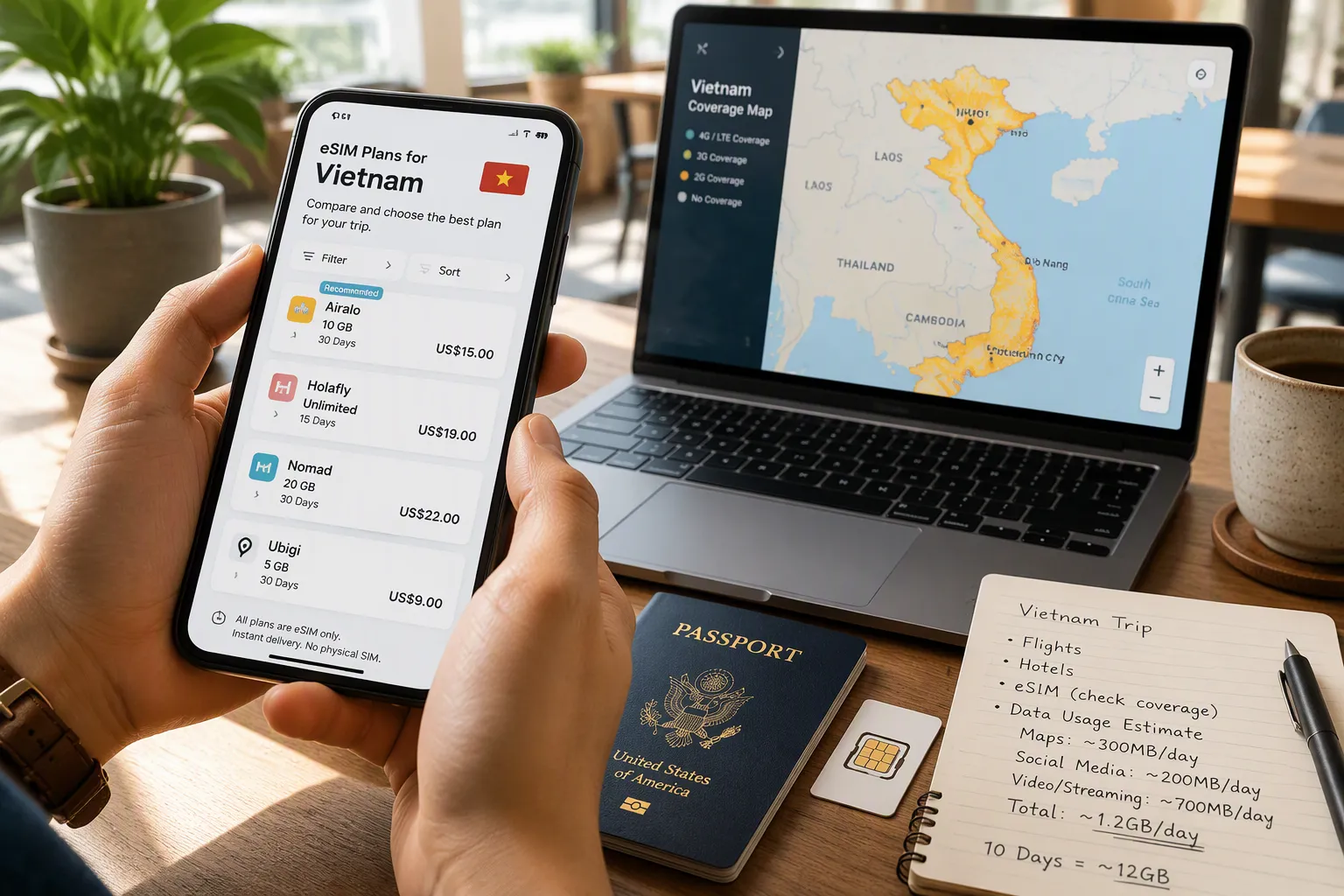
Start with your data habits. Maps eat 5-10 MB per hour. Social media burns 100-300 MB per hour. Video calls and streaming demand far more. Light travelers on a one-to-two week city trip need 5-10 GB. Moderate users on a two-to-three week journey need 10-20 GB. Heavy users and digital nomads need unlimited plans or 30+ GB.
Check the plan's validity period next. You want coverage for your entire trip without renewals. A Mobifone plan gives you 6GB per day for 10 days at $14.20. Viettel offers 5GB per day for 7 days at $11.70. Vinaphone sells unlimited data for 5 days at $7.10, though speeds drop after you hit the fair usage cap. Compare these against your itinerary length.
Coverage matters too. Viettel reaches remote areas with strong 4G and 5G. Vinaphone and Mobifone work well in cities and tourist spots. Pick a provider with responsive customer support, especially if you are new to eSIM technology. Save their contact details before you fly.
Common Mistakes to Avoid
Many travelers buy data-only eSIMs without realizing they lack a Vietnamese phone number. That creates problems with Grab, since drivers often call to confirm pickups. Zalo registration also requires a number. Keep your home SIM active for calls and texts, or use WhatsApp for hotel communication.
Setup errors trip up plenty of people. You must enable data roaming on the eSIM line. You must set the eSIM as your active data line. Some phones need a manual network selection. Restart your phone after landing. Check whether your plan's validity starts at purchase or first use.
Never install your eSIM at the airport. Tan Son Nhat, Noi Bai, and Da Nang WiFi can be slow and congested. Install at home before you fly. Some profiles need an internet connection to download. Finding the best eSIM for Vietnam Travel means avoiding these pitfalls before they cost you.
Finding the best eSIM for Vietnam Travel is your smartest move for staying connected without roaming fees. UUPAY, Holafly, Airalo, and Ubigi all deliver strong pricing, solid coverage, and easy setup. Buy and install your plan before you fly. Then land, connect, and enjoy hassle-free travel connectivity wherever your journey takes you.
FAQ
Will an eSIM really save me money over roaming?
Yes. UK networks charge around £6 per day for roaming. A Vietnam eSIM costs a fraction of that for a full month. You skip daily fees entirely.
Can I keep my home number while using a Vietnam eSIM?
Absolutely. Your eSIM handles data while your primary SIM stays active for calls and texts. You stay reachable without paying roaming rates.
Is UUPAY a safe choice for buying an eSIM?
UUPAY holds a US MSB license and PCIDSS Level 1 certification. It offers 24/7 global support. New users get a virtual card for 1U with 1U cashback, plus fee-free recharge.
See Also
Top Methods For Booking International Flights In Vietnam Using Virtual Crypto Cards
Step By Step Guide To Paying Overseas Utility Bills With USDT Visa Cards In Vietnam
Top Strategies For Using USDT Cards For Google Play Purchases In Vietnam
Optimal Methods For Using Bitcoin Debit Cards For Google Play In Vietnam
Selecting Thailand Crypto Cards For Effortless And Seamless Daily Spending
