Best Virtual Card for Thailand Digital Nomads

UUPAY is the best virtual card for Thailand digital nomads, mainly because it keeps fees low while handling Thai Baht well. You also get competitive exchange rates, wide acceptance for online and Thai QR payments, and a travel-friendly design. We'll fairly compare alternatives and show how our pick performs at ATMs, online, and with Thai QR.
Key Takeaways
UUPAY offers low fees and good Thai Baht rates. You save money on rent and groceries every month.
UUPAY works for online payments and Thai QR codes. You can pay at markets, cafés, and websites easily.
Keep a backup card like Wise for big transfers. This helps you avoid high ATM fees and cover emergencies.
Why Nomads Need a Virtual Card
Visa Context for Long Stays
Thailand now offers several long-stay routes, and each one keeps you in the country longer. That makes your card choice matter far more than it did on a two-week trip.
The Destination Thailand Visa (DTV) launched on July 15, 2024, for remote workers and freelancers. It is valid for 5 years with multiple entries, and each entry allows a stay of up to 180 days. You can extend once per entry for another 180 days at a ฿1,900 fee. The base application fee runs about ฿10,000, though embassy fees vary by location.
Visa | Validity | Cost |
|---|---|---|
DTV | 5 years | ~฿10,000 base fee |
LTR | 10 years (5 + 5) | ฿50,000 government fee |
Privilege Gold Card | 5 years | ฿900,000 membership fee |
The LTR visa targets high earners and skilled professionals. The Privilege Gold Card asks for no income proof, but it carries a steep membership fee.
Travel-Friendly Card Habits
Long stays change how you spend. You stop living like a tourist and start paying rent, buying groceries, and subscribing to services month after month.
Nomads commonly look for cards similar to Wise or Revolut, known for travel-friendly pricing. Many also show interest in prepaid debit cards for day-to-day payments. These habits make sense. A card that handles Thai Baht well and works online saves you money every single month.
Key Criteria for Thailand
Fees and Thai Baht Rates
Fees decide how far your money goes each month. You want to know the foreign transaction fee, the ATM withdrawal charge, and any hidden markup on the exchange rate. A card with a small percentage markup quietly drains your budget over a year of rent and groceries.
Thai Baht handling matters just as much. Look at the rate your card applies when you pay in THB. Some cards convert through USD first, and that double conversion costs you. Check whether the card lets you hold or top up in Baht directly. A clean Baht rate beats a flashy rewards program every time.
Acceptance and Compliance
A card only helps if merchants take it. You need solid acceptance for online payments — subscriptions, freelancing tools, flight bookings. Local QR payments matter too, since Thailand runs on PromptPay QR at markets, cafés, and small shops. Confirm your card supports Thai QR before you rely on it.
Support and compliance round out the list. Reliable customer service matters when a payment fails at midnight. Thai regulators also expect card providers to follow the rules, so pick a provider with real licenses. UUPAY, for example, states it holds a US MSB license, PCI DSS Level 1 certification, and 24/7 global support. Those credentials give you a paper trail if something goes wrong. Keep these five criteria in mind — fees, Baht rates, acceptance, support, and compliance — and the comparison ahead will make sense.
Finding the Best Virtual Card
Top Cards Compared
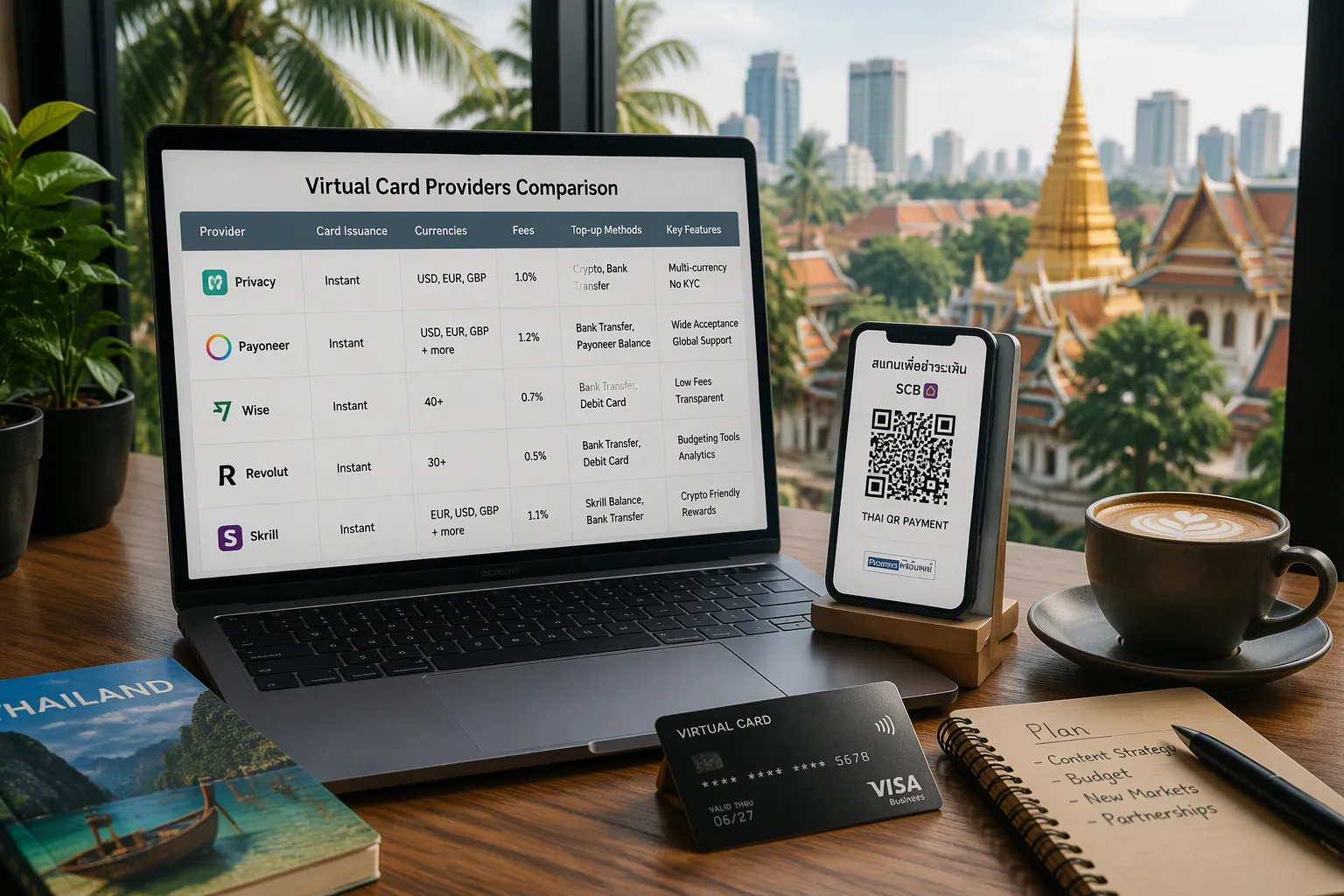
You now have five criteria to judge by. Here is how the main contenders stack up.
Provider | Fees and Thai Baht | Acceptance | Support and Compliance |
|---|---|---|---|
UUPAY | Low fees, competitive Baht rates, zero top-up fee promotion | Online payments plus Thai QR | US MSB license, PCI DSS Level 1, 24/7 global support |
Wise | Real mid-market rates with no markup; transfers cost roughly 0.5–1% versus $30–40 for a bank wire | Debit card works in Thailand; sends directly to Thai bank accounts | Transparent pricing; strong transfer tracking |
Revolut | Interbank exchange rates; minimal spending fees; ATM free up to a monthly limit, then fees apply | Multi-currency wallet, virtual and physical cards, local THB transfers | Not available to residents of some countries, including Thai residents |
N26 | Euro-focused account with travel-friendly card terms | Solid for online spending in Europe | Limited fit for Baht-heavy daily life |
Wise shines when you move money from a home bank account into a Thai bank account. Revolut gives you a polished app and budgeting tools. N26 works well if your finances stay mostly in euros. None of them, though, treats Thai QR payments as a first-class feature.
What Sets the Winner Apart
Two criteria separate UUPAY from the pack: Baht handling and local acceptance. Wise wins on transfer transparency, yet it is built around sending money, not spending it at a market stall. Revolut offers great rates, but Thai residents cannot open an account, which rules it out for many long-stayers.
UUPAY combines the pieces you actually use each day. You get low fees, a competitive Baht rate, online acceptance, and Thai QR support in one place. Add 24/7 support and a US MSB license, and the compliance picture looks solid too. That combination makes it the best virtual card for everyday life in Thailand, not just for moving money.
The gap widens further when you look at extras. UUPAY now offers a physical card, flight and hotel booking, eSIM, and chat features. A single app covers more of your nomad routine. For most readers, that convenience tips the scale.
Why UUPAY Wins
Features and Benefits
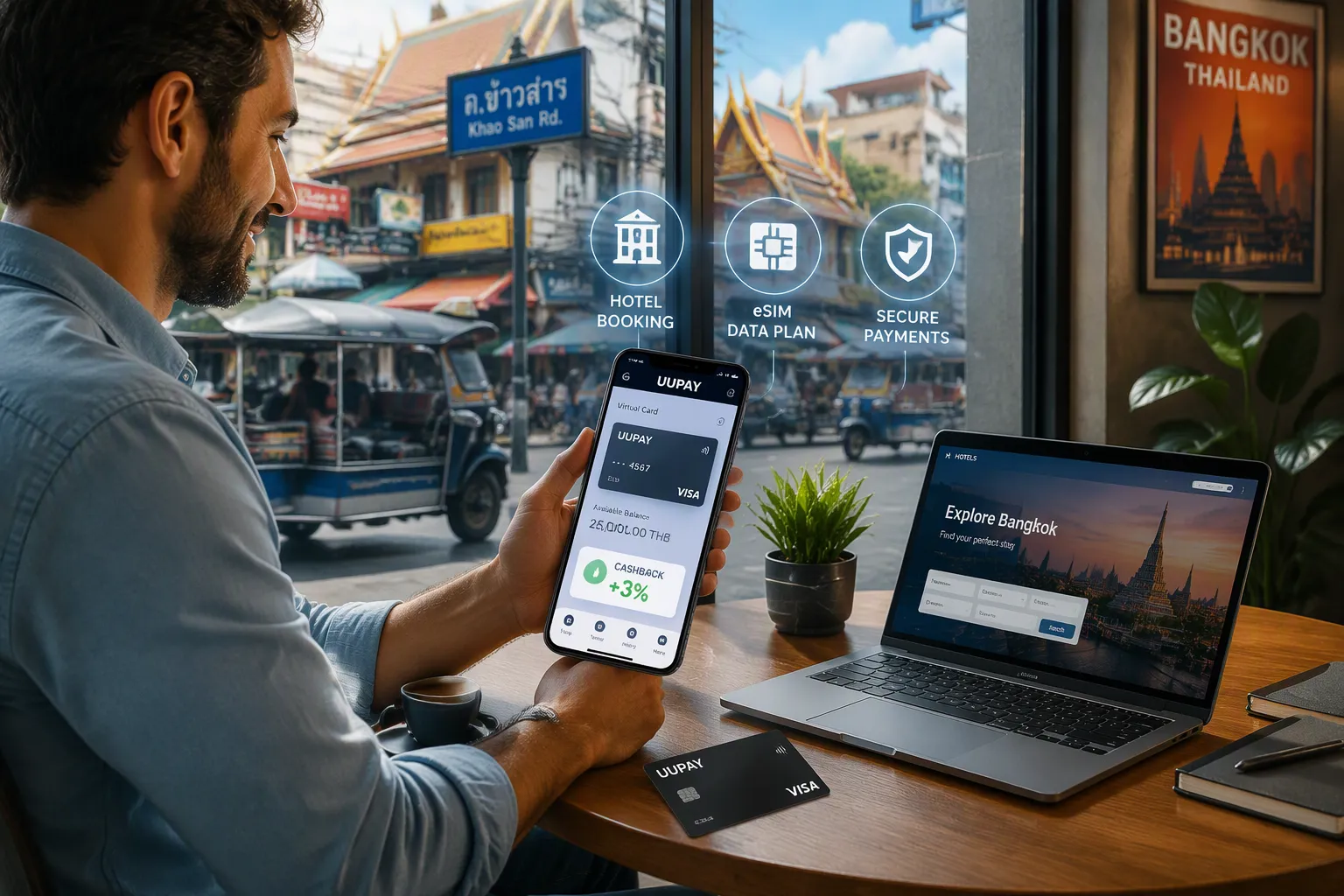
UUPAY earns its place through a mix of low costs and everyday usefulness. New users can open a virtual card for 1U and receive 1U cashback. Every user enjoys free top-up fees. Those two perks alone cut the small charges that pile up over a long stay in Thailand. You top up without losing a slice to fees, and your first card costs almost nothing. A competitive Baht rate means your rent and groceries cost less each month.
The physical card adds real flexibility. It works globally, lets you spend crypto easily, and offers up to 50% cashback. Security and instant issuance round out the package. You get a card that fits online checkout and a Bangkok café counter alike. Tap to pay at a street stall, or paste the number into a website. Crypto holders finally have a simple way to turn balances into everyday spending.
Extra services stretch the value further. UUPAY bundles hotel and flight booking, eSIM, and chat features into one app. You handle travel, connectivity, and support without juggling five different tools. One login covers more of your day. That saves time and keeps your nomad routine in one place.
Compliance backs all of this up. UUPAY holds a US MSB license, plus Swiss and Canadian licenses through subsidiaries. A Brazil license is pending, and Hong Kong registration meets Asian regulatory requirements. PCI DSS Level 1 certification and 24/7 global support complete the picture. That paper trail matters when a payment fails at an odd hour and you need a real person.
The referral program rewards you for sharing. Higher commission tiers come with more invites, and the top rate reaches up to 50% commission. For a nomad community that swaps tips constantly, that structure pays you back for helping friends.
Pros and Cons
No card is perfect, so here is a balanced view.
Pros: low fees, free top-ups, competitive Baht rates, online and Thai QR acceptance, a physical card with crypto spending and up to 50% cashback, bundled travel and eSIM services, strong multi-jurisdiction compliance, 24/7 support, and a generous referral program.
Cons: the Brazil license is still pending, crypto spending may not suit everyone, and the app bundles many features that new users must learn.
Weigh those points and the case looks clear. UUPAY delivers the strongest overall package for daily life in Thailand, which is why it stands as the best virtual card for most nomads. The pros cover the fees, acceptance, and support you use every week. The cons are minor and manageable with a backup plan. Keep a second card for emergencies, and you cover the gaps.
UUPAY in Real Use
ATMs and Online Payments
Picture your first week in Chiang Mai. You need cash for a motorbike deposit, and you need to pay for a coworking membership online. UUPAY handles both without drama. At the ATM, you withdraw Baht straight from your card balance. Check the machine's fee screen before you confirm, since Thai banks set their own withdrawal charges and those vary by bank. Take out larger amounts less often, and you dodge repeated fees.
Online payments feel just as smooth. You paste your virtual card number into a subscription page, a flight booking, or a freelancing platform, and the charge clears. Free top-ups mean you refill your balance without losing a cut to fees. Keep your virtual card for subscriptions and your physical card for counters and machines. That split limits your exposure if a merchant site ever leaks card details.
Thai QR and Daily Spending
Thailand runs on QR codes. You will scan PromptPay codes at street food stalls, coffee shops, and weekend markets. UUPAY supports Thai QR payments, so your phone becomes your wallet. Load a modest balance before a market day, scan, and pay in Baht. Keep the balance small for everyday spending and top up as needed.
Daily life rewards a simple routine. Pay small vendors by QR, use the card for groceries and rent, and keep some cash for places that still prefer it. Watch your balance before big purchases, and confirm your limits inside the app. If a payment fails, 24/7 global support gives you a real person to call. That safety net matters when you are far from home and a rent payment stalls.
Drawbacks and Alternatives
Where UUPAY Falls Short
No card fits every nomad perfectly, and UUPAY has a few honest gaps. The Brazil license is still pending, so if you split time between Thailand and South America, you might face extra verification steps. The app bundles many features — travel booking, eSIM, chat — which means a steeper learning curve than a simple card app. You will spend a few minutes exploring menus before everything clicks.
Crypto spending sits at the core of the physical card. If you never touch crypto, that feature adds nothing for you. The virtual card works fine with fiat top-ups, but the physical card's cashback rewards lean heavily on crypto usage. You can still use UUPAY without crypto, but you leave some perks on the table.
When Another Card Fits
Thai ATMs charge roughly ฿220 per foreign-card withdrawal. That fee stings if you pull small amounts often. Wise or Revolut help you avoid repeated ATM hits by moving money directly into a Thai bank account. You fund the account once, then spend from a local debit card.
Scenario | Why an alternative fits better |
|---|---|
Steep Thai ATM fees (≈฿220 per withdrawal) | Fintech cards avoid repeated costly ATM pulls |
Moving a large lump sum (motorbike, year's rent) | SWIFT transfers risk intermediary fees; fintech services are cheaper |
Waiting to open a Thai bank account | Use Wise or Revolut to fund the account once it's ready |
Managing routine living expenses | Send a periodic "salary" in THB via fintech instead of frequent withdrawals |
Wise shines for one-off transfers. You send a large amount, pay a transparent fee, and the Baht lands in your Thai account. Revolut suits you if you already use its budgeting tools and multi-currency wallet. N26 works only if your finances stay mostly in euros, so it fits a narrower slice of nomads.
UUPAY remains the best daily spending card. But for moving big money or waiting on a Thai bank account, Wise or Revolut earns its place in your wallet. Keep both, and you cover every scenario.
UUPAY is the best virtual card for most Thailand-based nomads. It keeps fees low, handles Baht well, and covers online and Thai QR payments.
Sign up in the app, claim the 1U card offer, and confirm your limits and QR support before you rely on it. Keep a backup card too. Safe travels, and happy spending!
FAQ
Does UUPAY work with Thai QR payments?
Yes. You can scan PromptPay QR codes at markets, cafés, and small shops. Load a small balance first, then pay in Baht straight from your phone.
What does it cost to get started?
New users open a virtual card for 1U and get 1U cashback right away. All users also enjoy free top-up fees, so refilling your balance costs nothing extra.
Is UUPAY safe and compliant?
It holds a US MSB license, plus Swiss and Canadian licenses through subsidiaries. You also get PCI DSS Level 1 certification and 24/7 global support when a payment stalls.
See Also
Top Crypto Card Options For Easy Spending In Thailand
Best Crypto Cards For Thai Users In 2026
Multi-Currency Crypto Cards For Managing Cross-Border Purchases In Thailand
Beginner Guide To Virtual Crypto Cards For Overseas Rent Of Digital Nomads
Best Ways To Use Virtual Crypto Cards For Booking Vietnam Flights
