ESIM vs Roaming: Cheapest Data for Canadians Travelling to the USA
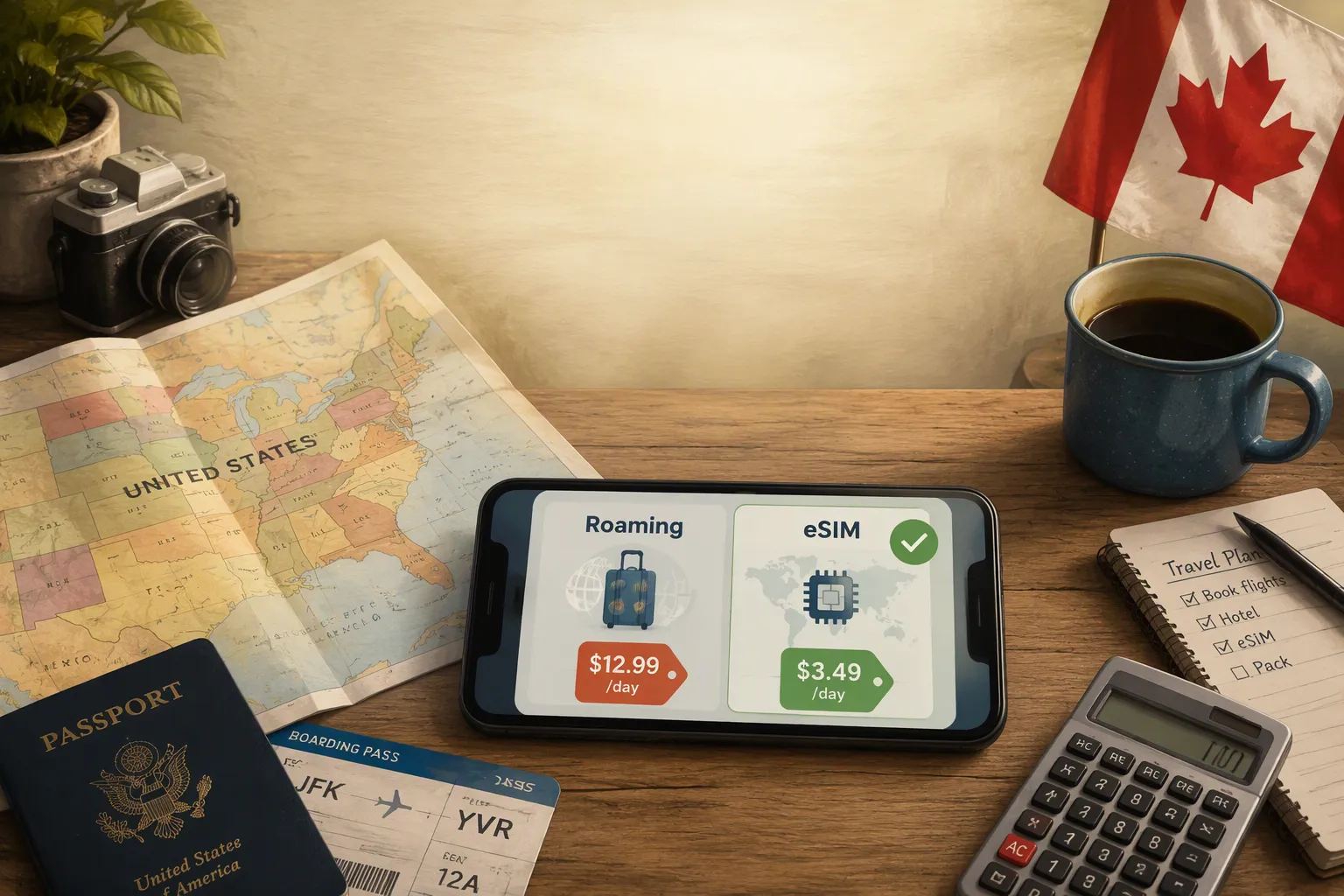
You cross into the USA and your carrier starts charging steep daily fees. Rogers bills $12/day, Bell $13/day, Telus $14/day. Most travelers overpay without noticing. For most Canadians, an eSIM costs far less than roaming. Finding the cheapest data for Canadians travelling to the USA takes one comparison. This guide shows exact costs, setup, and hidden limits.
Key Takeaways
An eSIM provides the cheapest U.S. data for Canadians. It costs less than one day of roaming. Install it before you leave.
Dual SIM keeps your Canadian number active. Your travel eSIM handles data. This setup avoids roaming fees and saves money.
Match your eSIM plan to trip length and data use. Short trips need smaller plans. Long stays need unlimited data.
Roaming vs eSIM: Cheapest Data for Canadians Travelling to the USA
You pay twice for U.S. data when you roam. First, you pay your regular monthly plan at home. Then, you pay a daily surcharge the moment your phone touches a U.S. tower. Most travelers never calculate the real number until the bill arrives. This comparison shows exactly where the money goes. You can check costs in five minutes and pick the right option before you cross the border.
What Canadian Carriers Charge for Roaming
Canadian carriers charge a flat daily rate for roaming in the USA. The fee activates on any day you use your phone, even if you only check one email. Sending a single text triggers the full charge. The table below shows what the big five carriers charge in 2025.
Carrier | Daily Cost (USA, 2025) |
|---|---|
Rogers | |
Bell | $13/day |
TELUS | $16/day |
Fido | $16/day |
Koodo | $16/day |
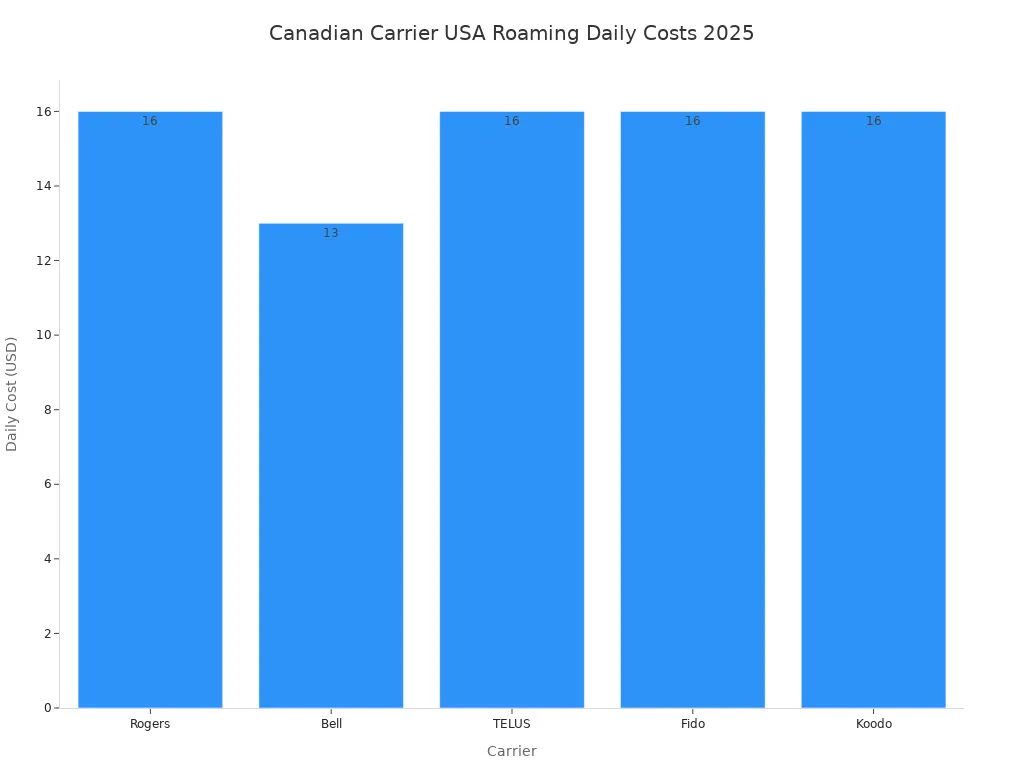
For a 7-day trip, carrier roaming lands between $91 and $112 CAD. Bell charges $13/day, producing a $91 week. Rogers, TELUS, Fido, and Koodo charge $16/day, bringing the same seven days to $112. Most carriers cap roaming charges at 20 days per billing cycle, but that cap matters only on extended stays. You pay the daily rate in full for every day your phone connects to a U.S. network, whether you use 10 MB or 10 GB.
Typical eSIM Prices for the USA
eSIM providers sell data plans for a fraction of roaming prices. You buy a plan online, install it as a digital SIM, and your phone connects to a U.S. network automatically. No physical card, no store visit, no contract change. The cheapest data for Canadians travelling to the USA usually comes from this route. Providers like UUPAY also offer competitive plans, giving travelers another option.
Provider | Duration | Plan | Price |
|---|---|---|---|
Airalo | 7 days | 1 GB | |
Airalo | 30 days | 3 GB | C$13.00 |
Airalo | 30 days | 5 GB | C$20.00 |
Airalo | 30 days | 10 GB | C$32.50 |
Airalo | 30 days | 20 GB | C$52.50 |
Holafly | 7 days | Unlimited | C$40.00 |
Holafly | 30 days | Unlimited | C$103.00 |
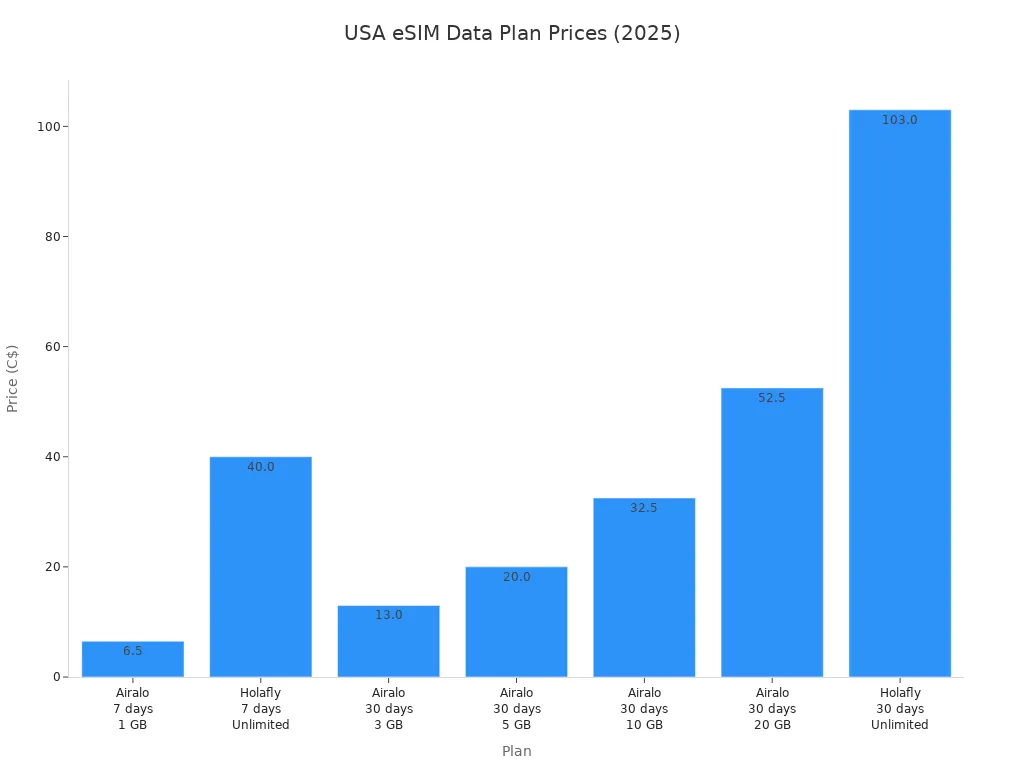
Holafly sells a 7-day unlimited data plan for C$40.00. A similar week of carrier roaming costs up to $112. Airalo serves light users with a 7-day, 1 GB plan at C$6.50 — cheaper than a single day of carrier roaming. Monthly plans stretch the savings further. Airalo's 20 GB, 30-day plan costs C$52.50. Holafly's unlimited 30-day plan runs C$103.00.
The gap widens on longer stays. Carrier daily fees keep multiplying for every day you remain inside the country. A Holafly 30-day unlimited plan costs C$103.00 and removes the daily meter entirely. Travelers who plan ahead lock in the low rate before departure.
What Is an eSIM and How Does It Work?
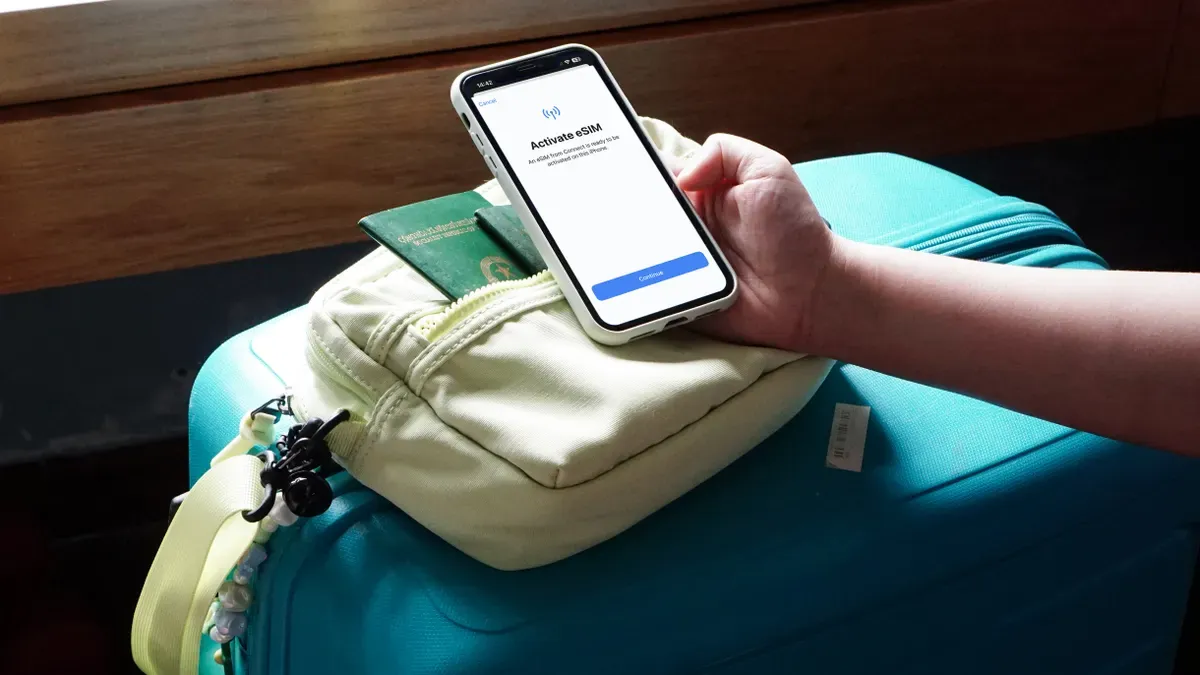
An eSIM is a digital SIM built into your phone. You download it instead of inserting a plastic card. You connect to a new mobile data provider through an app or QR code. The eSIM activates and gets online within seconds.
Once installed, an eSIM works like a physical SIM. It connects your device to participating mobile networks. You can install a travel eSIM before departure using Wi-Fi. Usage and validity only begin when the eSIM connects to an overseas network.
eSIM vs Physical SIM
Dimension | Physical SIM | eSIM |
|---|---|---|
Network switching | Requires removing and inserting a new card | Carrier profiles stored digitally; switching done instantly in phone settings |
Security | Card is removable and can be taken out | Built into device hardware; can be remotely disabled if phone is lost |
Convenience | Setup requires physical card and SIM tray | Activated digitally via QR code; supports multiple profiles |
An eSIM stores connectivity details electronically. It can hold multiple carrier profiles. You switch between carriers remotely without a physical SIM swap. Dual SIM functionality lets you manage personal and business lines on one device. eSIMs are less susceptible to physical damage, loss, or theft.
Checking Phone Compatibility
Not every phone supports eSIM. You should check your device before buying a plan. Most newer phones work with eSIM technology.
Apple iPhone: Air, Duo, 13 series and newer, SE (3rd generation)
Google Pixel: Pixel 8 series and newer
Samsung Galaxy: S24 series and newer, S24 FE and newer, XCover7 Pro, Z Flip6, Z Fold6 and newer, Z Fold8 Ultra, A16, A17, A35, A37, A56, A57
If your phone appears on this list, you can use an eSIM for your USA trip. Check your phone settings under "Cellular" or "Mobile Network" for an "Add eSIM" option.
How to Set Up a UUPAY eSIM
UUPAY delivers the cheapest data for Canadians travelling to the USA, provided you install the eSIM before leaving home. The process takes minutes, and you manage everything from your phone.
Step-by-Step Installation
Download the UUPAY app and create an account. New users receive 1U cashback when they open a virtual card for 1U, which cancels the initial fee. The platform also waives card recharge fees. A physical card launch now gives travelers a plastic option for backup. After registration, browse the USA plans inside the app. Select the one that fits your trip length and usage.
Most newer iPhones, Pixel devices, and Samsung Galaxy phones support eSIM. Confirm your device in settings before buying. Then choose "Install eSIM" and scan the QR code shown on your screen. The profile stays dormant until you reach the USA. Finishing the setup on home Wi-Fi gives you a smooth start. You can run the travel eSIM alongside your Canadian SIM without removing anything.
Trust matters when you download network credentials. UUPAY holds a US MSB license plus Canadian and Swiss licenses. A Brazilian license is pending. The company is registered in Hong Kong and holds PCIDSS Level 1 certification for secure payment handling. Around-the-clock global support means you can resolve any installation issue before departure, not after you cross the border.
Activating at the Border
Your UUPAY eSIM activates automatically the moment your phone connects to a U.S. tower. No toggles, no customer-service calls, no waiting. Plan validity starts with that first connection, so you land and go straight online. If you enable dual SIM, your Canadian number stays active for calls and texts while the UUPAY eSIM handles data. Verify that your device supports this feature before you leave, because call capability depends on both the phone and the plan.
After activation, the savings continue. UUPAY offers up to 50% rebate on qualifying usage. Referral commissions reach 50% when you invite other travelers. That structure makes the eSIM cheaper over time, especially for frequent border crossers. Combine the rebate with the low plan price, and the total cost stays far below carrier roaming rates.
eSIM Drawbacks and Roaming Perks
An eSIM saves money, but it comes with real trade-offs. You should understand these limits before you buy.
eSIM Limitations to Know
Device compatibility tops the list. Many phones lack eSIM hardware entirely. Wi-Fi-only tablets, GPS-only smartwatches, budget Android models, and phones sold in Mainland China cannot use an eSIM. Carrier-locked phones restrict eSIM to the original carrier. Imported phones may miss the LTE or 5G bands your U.S. network needs. Check for an "Add eSIM" option in your settings, or dial *#06# to see if an EID number appears.
Device Category | eSIM Support |
|---|---|
Wi-Fi-only tablets | No |
GPS-only smartwatches | No |
Budget Android phones | No |
Phones sold in Mainland China | No |
Carrier-locked phones | No |
Data-only plans create a second limitation. Most travel eSIMs do not include a phone number. You cannot make or receive calls from your Canadian number. Two-factor authentication codes from your bank become harder to access. A data-only eSIM needs Wi-Fi Calling or a VoIP service to handle voice and SMS.
When Roaming Still Makes Sense
Traditional roaming wins in a few specific cases. You need your Canadian number for calls, banking codes, or two-factor authentication. Telecom expert Mohammed Halabi notes that eSIMs are not optimal for customers who need phone-number access. He personally favors carrier travel passes for travelers who value convenience over cost.
You want full access to your existing plan's data, talk, and text in the U.S.
You prefer a simpler setup and will pay more for it.
You need reliable two-factor authentication by text.
Rogers' 14-day U.S. travel pass costs $60, compared with the $16 per-day roaming rate. That pass covers calls, texts, and data. A UUPAY eSIM costs far less, but it mainly handles data. Match the tool to your needs.
Tips to Maximize Your Data Savings
Use Dual SIM to Keep Your Number
Dual SIM lets you run your Canadian SIM and a U.S. eSIM at the same time. Your Canadian number stays active for calls and texts. The eSIM handles your data. You avoid roaming fees on data while keeping your number reachable.
Setup takes a few steps on iPhone. Open Settings, then General, and confirm your device runs iOS 13.0 or later. Enable Wi-Fi Calling for each line under Settings > Phone > Wi-Fi Calling. Tap Cellular Data and choose which line provides your default data. Turn Allow Cellular Data Switching to ON. Two active eSIM lines work only on iPhone 13 series, iPhone SE (3rd generation), or newer. Each line needs its own rate plan and bills separately.
Match the Plan to Your Trip
Plan size matters more than brand. A 1 GB, 7-day plan costs $3.99 USD. A 5 GB, 30-day plan runs $13.99 USD. Unlimited plans range from $34.99 to $71.99 USD for 10 to 30 days. Short trips need less data. Longer stays need more.
Compare across 220+ providers and 14,300+ plans. Filter by lowest price or unlimited data. Airalo's 5 GB plan suits short trips. Sim Local's unlimited options fit heavy users. A UUPAY eSIM also delivers strong value for Canadians who want a trusted, compliant provider. Match your plan to your trip length and data habits. You lock in the lowest cost before you cross the border.
Best Option for Your Trip
The right choice depends on two variables: trip length and data appetite. A weekend visitor and a snowbird face very different cost structures. Match the plan to your usage and you lock in the savings before departure.
Short Trips and Light Data Users
For a weekend stay, a small prepaid USA eSIM covers maps, messaging, hotel details, restaurant searches, and rideshares. If your Canadian number must stay active and the trip lasts only a day, carrier roaming may be simpler. But if data is the primary need, a travel eSIM avoids daily roaming fees.
Light users typically need 1-3 GB per week for maps, messaging, email, and quick searches. A single GB plan often covers the full weekend. Budget travelers get the best value from a low-cost prepaid eSIM. Airalo offers easy country plans in this range.
The data need changes with the destination. In Las Vegas, a smaller plan may suffice if you stay on hotel Wi-Fi. In New York City, maps and transit apps are the biggest drain. In Florida, theme park apps and rideshare apps consume steady data.
For a light user, the cheapest data for Canadians travelling to the USA comes from a small fixed-data eSIM. You pay once and never face a daily surcharge.
Long Stays and Heavy Data Users
One-week vacations change the math. Daily roaming fees accumulate quickly. A travel eSIM eliminates that meter. Regular travelers need 5-10 GB per week. Heavy users need 10-20 GB for photo uploads, video calls, and navigation.
Traveler Profile | Recommended Plan | Rationale |
|---|---|---|
Regular vacationer | 5-10 GB eSIM | Maps, social media, travel apps |
Road trip driver | Larger eSIM with hotspot | Navigation, music, uploads add up |
Remote worker | 20 GB+ or unlimited | Video meetings drain data |
Family trip | Separate eSIM per phone | Per-line roaming costs multiply |
Road trips demand more. Navigation, hotel apps, music streaming, and photo uploads add up fast. A larger eSIM with hotspot support shares data with your laptop or tablet. Remote workers drain 20 GB or more per week. An unlimited-style plan removes the worry.
Families should install separate travel eSIMs on each compatible phone. Per-line roaming costs multiply, so a per-line strategy saves real money. For families seeking the cheapest data for Canadians travelling to the USA, this beats carrier roaming by a wide margin. Snowbirds need a predictable setup; a larger USA plan works best for months on the road.
For all these profiles, the cheapest data for Canadians travelling to the USA remains a UUPAY eSIM or comparable prepaid plan. You keep the Canadian line active through dual SIM while the travel eSIM handles data. Hotel Wi-Fi reduces mobile needs; hotspot use and photo backups increase them. Match the plan size to the trip.
An eSIM — such as a UUPAY plan — is the cheapest data for Canadians travelling to the USA. You pay a fraction of daily roaming fees. Buy and install your eSIM before departure. You then avoid roaming charges entirely and land connected.
FAQ
Is an eSIM really cheaper than roaming for a USA trip?
Yes. Carrier roaming costs up to $16 per day. A UUPAY eSIM or similar prepaid plan delivers the cheapest data for Canadians travelling to the USA, often for less than one day of roaming.
Can I keep my Canadian number while using a U.S. eSIM?
You can. Dual SIM keeps your Canadian line active for calls and texts. Your eSIM handles data. Check that your phone supports two active eSIM lines before you travel.
Does my phone work with a U.S. eSIM?
Most newer iPhones, Google Pixel devices, and Samsung Galaxy phones support eSIM. Open your phone settings and look for an "Add eSIM" option. If it appears, your device is compatible.
See Also
Expert Guide To Using USDT Visa Cards For Daily Budgeting As Digital Nomads
Advanced Tips For Booking Overseas Hotels With USDT Cards For Global Travelers
Starting Guide To Virtual Crypto Cards For Paying Overseas Rent As Digital Nomads
How To Use USDT Prepaid Cards To Pay Overseas Rent As Freelancers Abroad
Using USDT Visa Cards To Manage Daily Expenses For Cross-Border Sellers
