5 Cheapest Ways to Do a TRC-20 USDT Top-Up
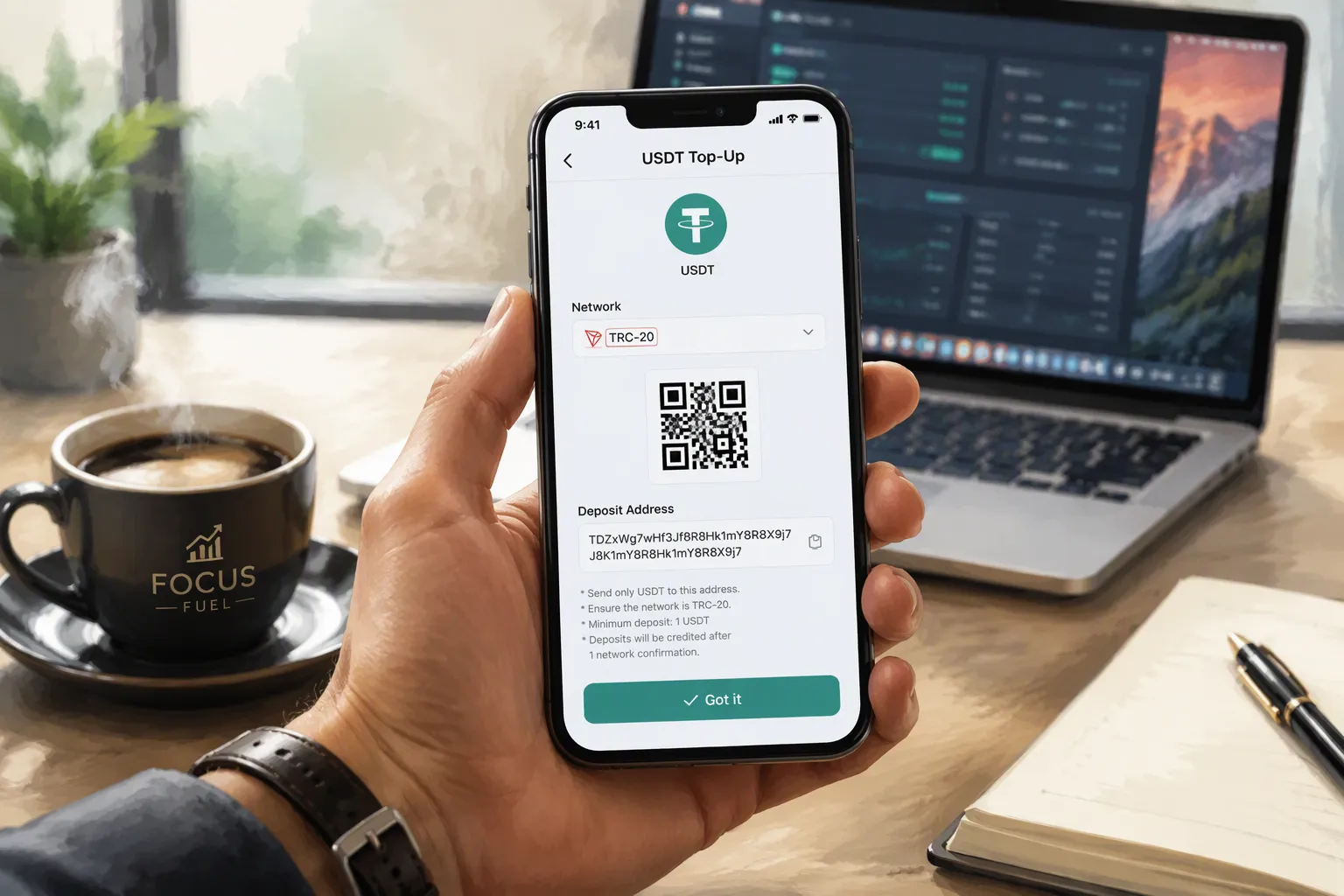
For SEA users, the cheapest TRC-20 USDT Top-Up runs through a low-fee local payment platform like UUPAY. Energy-saving services and free-deposit exchanges come close behind. Here's the ranking: UUPAY, TR.ENERGY, XREX, P2P trading, then card purchases. Each method gets fees, steps, and pros and cons, plus a comparison table.
Key Takeaways
UUPAY offers the lowest overall cost for a TRC-20 USDT top-up for Southeast Asian users.
Rent energy to cut network fees by up to 52% on TRC-20 USDT transfers.
Always compare the total cost, not just the advertised fee, to avoid hidden charges.
TRC-20 USDT Top-Up Fees Explained
Network Fee vs. Platform Fee
Here's some good news first. A TRC-20 transfer on Tron already costs far less than an ERC-20 transfer on Ethereum. So the real savings on a TRC-20 USDT Top-Up come from platform fees and FX spreads, not from the chain itself.
You pay two separate costs on every top-up. The network fee is the on-chain charge for energy and bandwidth on Tron. The platform fee is what an exchange or wallet charges you for handling the transaction. Some services hide the network fee inside a flat rate. Others bill it separately. Always check which one you're looking at.
Why SEA Users Pay More
Southeast Asia has specific cost drivers that push top-up prices up. Local payment rails are limited in many markets, so platforms route your money through extra intermediaries. Each hop adds cost.
Currency conversion is the second driver. You fund in PHP, THB, VND, or IDR, and the platform converts to USDT. That spread often costs more than the visible fee. Card processing adds a third layer. Card networks charge merchants a percentage, and that cost lands on you. Pay by local bank transfer or e-wallet instead, and you usually skip it.
Method 1: UUPAY Local Payment Top-Up
UUPAY earns the top spot for one simple reason. It accepts the payment methods you already use across Southeast Asia, and its platform fees stay low. You skip the card processing markup and the extra currency hops that inflate other routes. New users also get a virtual card opening fee of just 1U, with 1U cashback paid immediately. Card top-up fees are completely free for all users.
Fees and Limits
Expect a small platform fee on each top-up, plus the standard Tron network charge. UUPAY keeps both low by settling through local rails instead of routing your money through foreign intermediaries. Limits vary by payment method and verification level, so check the app before you commit. Verify current fees and caps before publishing or transacting, since rates shift with network conditions.
Step-by-Step Guide
Create your UUPAY account and complete verification.
Select TRC-20 USDT as your top-up asset.
Choose your local payment method, such as a bank transfer or e-wallet.
Confirm the amount and review the total cost.
Receive USDT in your wallet, usually within minutes.
That's your TRC-20 USDT Top-Up done at the lowest overall cost. UUPAY holds a US MSB license, a Swiss license through its subsidiary, a Canadian license, and a Hong Kong registration that meets Asian regulatory requirements. It is also PCI DSS Level 1 certified, with 24/7 global support. Beyond top-ups, you can book flights and hotels, buy an eSIM, and chat in-app. The physical card is now live too, letting you spend crypto globally with up to 50% cashback. Invite friends and your commission level rises, up to 50%.
Method 2: TR.ENERGY Energy Saving
How Energy Cuts Fees
Tron charges you in energy and bandwidth for every transfer. If your wallet holds none, the network burns TRX from your balance to cover the cost. That burn is where your money quietly disappears. Renting energy instead of burning TRX changes the math in your favor. A TronDAO forum guide reports savings of up to 52% on TRC-20 USDT transactions when you use rented energy.
Trust Wallet is one example of a wallet that lets you use energy and bandwidth for the lowest send fees. You hold the energy, the network draws on it, and your TRX balance stays untouched. The saving is real, and it compounds if you send USDT often.
Setup and Steps
The process stays simple. You buy or rent energy first, then send USDT as normal. Here is the flow:
Pick an energy provider and rent enough to cover your transfer.
Confirm the energy lands in your wallet address.
Send your USDT the usual way and let the network draw on the rented energy.
Watch the rental window. Energy expires after a set period, so rent close to the moment you send. Rent too early and you waste the fee. For a one-off TRC-20 USDT Top-Up, the saving may be modest. Send often and the 52% figure starts to matter.
Method 3: XREX Free-Deposit Route
Fee Breakdown
XREX supports TRC20-USDT, and it charges nothing to deposit. That single feature changes the math on your TRC-20 USDT Top-Up. You move fiat onto the exchange for free, convert it, and withdraw as USDT. Withdrawal fees run substantially cheaper than what most exchanges charge for the same route.
The savings stack up when you already hold fiat on an exchange. You skip the card markup and the local payment intermediary entirely. Your only real costs are the conversion spread and the withdrawal fee, and both stay modest on this platform. Compare that to a card purchase, where processing costs eat into every dollar.
Pros and Cons
The pros are easy to list. Deposits cost you nothing. Transfers move fast, so your USDT lands quickly. The fee structure stays simple and predictable, which makes budgeting straightforward.
The cons deserve equal attention. XREX requires full KYC, so you'll submit identity documents before you start. Availability also varies by country, and not every SEA market gets full access. Check that your region is supported before you commit.
Verify the current withdrawal fee and your country's eligibility on XREX before you rely on this route.
If you already keep fiat on an exchange and want speed without card fees, this route works well. If you'd rather pay in local currency directly, a local payment platform still beats it on total cost.
Method 4: P2P Trading on Exchanges
Fees and Local Payment Options
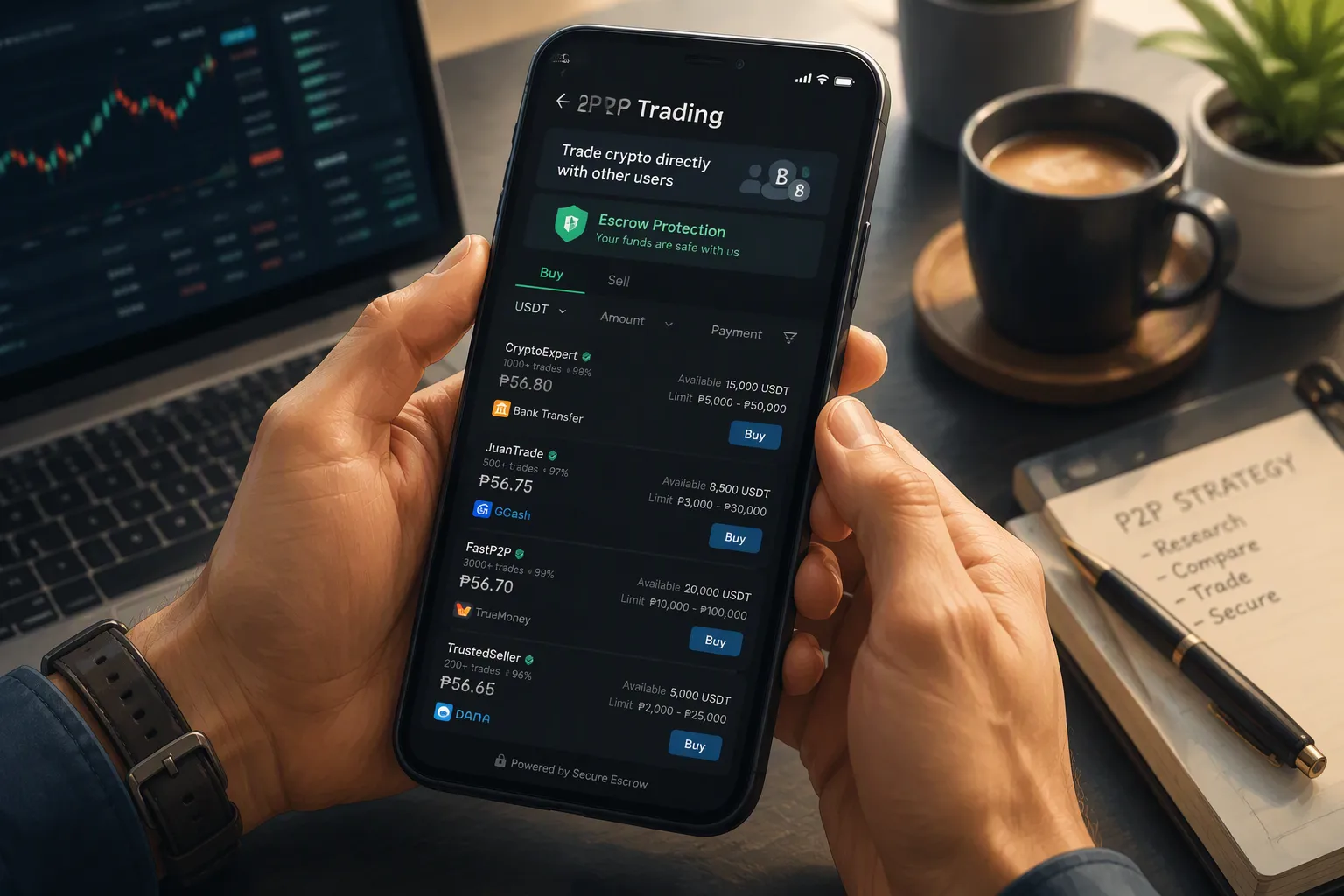
Peer-to-peer trading cuts out the middleman entirely. You buy USDT directly from another person instead of from a platform's inventory. This opens up payment methods you already use daily. Bank transfers, GCash, TrueMoney, DANA—whatever your local e-wallet happens to be, you'll likely find a seller who accepts it.
The fee structure looks attractive at first glance. Most exchanges charge zero platform fees for P2P trades. You pay a small price spread instead. Sellers set their own rates, usually a fraction above the market price. For a typical TRC-20 USDT Top-Up, that spread lands somewhere between 0.5% and 2%, depending on demand and liquidity in your region.
You'll find P2P markets on major exchanges like Binance, OKX, and Bybit. Each platform shows you available sellers, their rates, and their payment methods. You pick one, send the local currency, and the seller releases USDT to your wallet. The whole process takes minutes when everything goes smoothly.
Safety Tips
Here's where you need to pay attention. P2P trading attracts scammers because money moves directly between strangers. Some sellers ask you to release funds before they send USDT. Others use fake payment screenshots to claim they've paid when they haven't. The risk is real, and it's the main reason this method sits fourth on our list.
Always use escrow-backed P2P platforms. The exchange holds the seller's USDT in escrow until you confirm payment. If the seller never releases the crypto, the platform steps in and refunds you. Never trade outside the platform's chat system. Never accept a "better deal" that requires direct bank transfer. Those deals are how people lose money.
Only trade on platforms with escrow protection, and never move funds outside the exchange's official P2P system.
Stick to sellers with high completion rates and long trading histories. Check their feedback before you commit. A few extra minutes of due diligence beats losing your entire top-up amount to a scam.
Method 5: Card Purchases via Paybis and CEX.IO
Card purchases sit last on the list, and the reason is simple. You pay for convenience, and you pay a lot. Still, this route has its place, especially when you need USDT fast and small.
Why Card Fees Are Higher
Card networks charge merchants a processing percentage on every transaction. That cost lands on you. On top of it, the platform adds its own markup for handling the card payment and the crypto conversion. Stack those two layers together, and your total cost climbs well above what a local bank transfer would cost you.
Paybis lets you buy with a card up to $1,000 without verification. Higher limits need approval, which takes about 5 minutes. That speed is the trade-off you accept for the higher fee. CEX.IO works as a free mobile and desktop wallet for buying, storing, and transferring TRC20 USDT. It keeps your coins in one place, but the card route into it still carries the same processing markup.
Check the total charge on the confirmation screen before you pay. The card fee often hides inside the quoted rate.
When It Still Makes Sense
Speed matters when you need a TRC-20 USDT Top-Up in a hurry. A card clears in minutes, and you skip the bank transfer wait. Small amounts also make the fee easier to swallow. Paying a few dollars extra on a $50 purchase stings less than on a $500 one.
Use this method as a backup, not a habit. When you have time, a local payment platform or an energy-saving route will save you real money. When you don't, the card gets you there.
Cheapest TRC-20 USDT Top-Up Methods Compared
Comparison Table
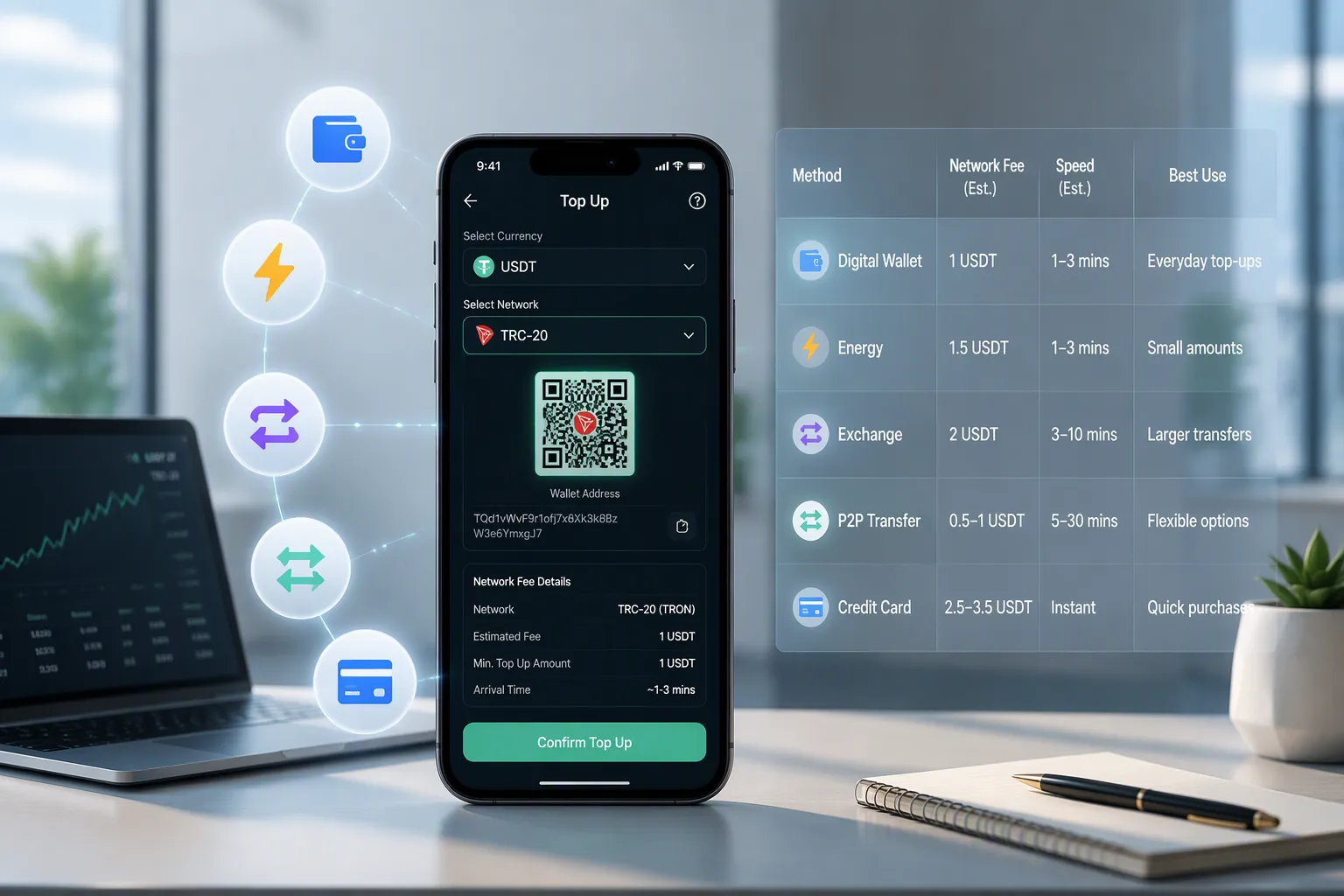
The table below lines up all five routes side by side. Fee ranges are general, so verify current figures on each platform before you commit.
Method | Typical Fee Range | Speed | Best For |
|---|---|---|---|
UUPAY | Lowest overall; small platform fee plus standard network charge | Minutes | SEA users paying in local currency |
TR.ENERGY | Low; up to 52% saved on network costs with rented energy | Minutes | Frequent senders who plan ahead |
XREX | Low; free deposits, cheap withdrawals | Fast | Users already holding fiat on an exchange |
P2P | Small price spread, often no platform fee | Minutes | Users with local e-wallets and patience for due diligence |
Card purchases | Highest; card processing markup plus conversion | Minutes | Urgent, small top-ups |
How UUPAY Stacks Up
UUPAY wins on total cost for most Southeast Asian users. You pay in the currency you already hold, so you dodge the card markup and the extra conversion hops that inflate every other route. The platform fee stays small, and the network charge is the same one every method pays.
The extras tip the scale further. New users open a virtual card for just 1U and get 1U back immediately. Card top-up fees are free for everyone. The physical card is live now, letting you spend crypto worldwide with up to 50% cashback. You also get flight and hotel booking, eSIM purchase, and in-app chat in one place.
Compliance backs all of it. UUPAY holds a US MSB license, Swiss and Canadian licenses through its subsidiaries, and a Hong Kong registration that meets Asian regulatory requirements. It is PCI DSS Level 1 certified with 24/7 global support. Invite friends and your commission level climbs, up to 50%.
TR.ENERGY suits you if you send often and can rent energy close to send time. XREX works when your fiat already sits on an exchange. Neither beats UUPAY on a plain local TRC-20 USDT Top-Up, though. For most readers, UUPAY delivers the lowest all-in cost with the least friction.
Smart Tips to Cut Top-Up Costs
Timing and Network Conditions
Tron network congestion moves your costs up and down. Check current conditions before you send. A busy chain burns more TRX to cover energy, so your transfer costs more than it would on a quiet day. Watch the network for a few minutes and pick a calm window when you can.
Batching helps too. Send one larger transfer instead of several small ones. Each transfer carries its own network charge, and that charge is roughly 1 USDT, deducted on-chain. Three small sends triple that cost. One combined send pays it once. Plan your top-ups around this habit and the savings add up quietly.
Avoiding Hidden Fees
Advertised rates rarely tell the whole story. One provider markets a 0% top-up fee with "no hidden spreads" and "no surprise charges," yet its own policy page documents recovery fees, minimum thresholds, and AML freezes. Treat that marketing as a claim to verify, not a fact.
Check the fine print before you trust a "no hidden fees" promise.
Some charges hide inside the exchange rate rather than appearing as a separate line. Others only surface when something goes wrong. A wrong-network deposit can trigger a recovery fee of $50 or 10% of the deposit value, and deposits under $100 are not recovered at all. Amounts below a stated minimum go uncredited and cannot be refunded. Watch for "flash USDT" too — it can sit in your wallet for up to 90 days before the blockchain rejects it. Compare the total cost of your TRC-20 USDT Top-Up, not the headline number.
UUPAY gives most SEA users the cheapest TRC-20 USDT Top-Up. Keep TR.ENERGY and XREX as backups: one saves on energy, the other on exchange deposits. Always compare total cost, not the advertised fee. Try UUPAY first for a low-fee local top-up, and check current fees before every transaction.
FAQ
Which method is cheapest for a TRC-20 USDT Top-Up?
UUPAY usually wins. You pay in local currency, skip card markup, and dodge extra conversion hops. New users open a virtual card for 1U and get 1U back.
Is energy rental worth it for a single transfer?
Often not. Rent energy close to send time, or the rental expires and you waste the fee. Frequent senders save more than one-off users.
Should I ever pay card fees on purpose?
Yes, when speed beats cost. Cards clear in minutes and suit small amounts. Treat them as a backup, not your default route.
See Also
Guide to Using USDT Debit Cards for Everyday Payments
Top Seven Taiwan USDT Cards to Consider in 2026
Advanced USDT Visa Card Guide for Unbanked Daily Crypto Spending
Best USDT Debit Card Choices for Simple Crypto Payments
Discover the Advantages of USDT Cards for Smooth Transactions
