Comparing Fees of Leading Crypto Cards in 2026

You want the lowest crypto card fees in 2026. Annual fees range from $0 up to $1,499, with FX fees near 1.5%, swap fees starting at 1%, and APRs reaching 29.99%. Look beyond the basics—hidden costs, reward rates, and yield flexibility shape the true value of crypto credit cards.
UUPAY stands out as a benchmark for comparison.
Key Takeaways
Look for crypto cards with no annual fees and free ATM withdrawals to save money. Cards like Nexo and Coca offer these benefits.
Calculate your breakeven point to see how much you need to spend to cover annual fees with rewards. This helps you choose the best card for your spending habits.
Be aware of hidden fees such as foreign transaction charges and swap fees. These can reduce your overall rewards and impact your savings.
Crypto Card Fees Comparison

Fee Overview
You want to understand how crypto card fees stack up in 2026. The landscape includes a wide range of annual fees, ATM withdrawal costs, and reward rates. Some crypto cards offer zero annual fees, while others charge up to $1,499 for premium perks. You should always check the details before you choose a card, because the fee structure can impact your daily spending and long-term rewards.
Here is a comparison table of leading crypto cards and their main fee structures:
Crypto Card | Annual Fees | ATM Withdrawal Fees |
|---|---|---|
UUPAY | $0 - $1,499 | 0% up to $400/month, then 2% |
Nexo | None | Limited free withdrawals by loyalty tier, then 2% |
Coca | None | None globally up to $200 monthly |
Bitget Wallet Card | None | Fees set by regional partner and local banks |
Brighty | €0 - €216 | EEA: €3.00 - €3.50; Non-EEA: €3.00 - €3.50 + 3-3.5% (plan dependent) |
Cypher | $0 (Standard), $199 | Standard: 3%; Premium: 2% |
Coinbase | None | None (ATM operator fees may apply) |
Bybit | None | Free for first 100 EUR/GBP/month, then 2% |
ether.fi Cash | 0.01 - 1 ETH | Fixed 2%, $10K limit, 3 withdrawals/day |
MetaMask | None (Virtual), $199 | 2% |
KAST Regular Cards | Free - $10,000 | $3 + 2% local, $3 + 2% (+2% FX) international |
You see that crypto card fees can vary a lot. Some cards, like Nexo and Coinbase, keep annual fees at zero. Others, such as UUPAY and KAST, offer premium tiers with higher annual fees for extra benefits. ATM withdrawal fees also differ. Some cards give you free withdrawals up to a monthly limit, while others charge a percentage or a flat fee.
When you look at reward rates, you find a similar range. In 2026, most crypto cards offer effective reward rates between 0.8% and 2.5% after accounting for fees and spreads. If you choose a high-tier card and stake tokens, you might reach 3% to 4% in rewards, but only if your staked assets keep their value.
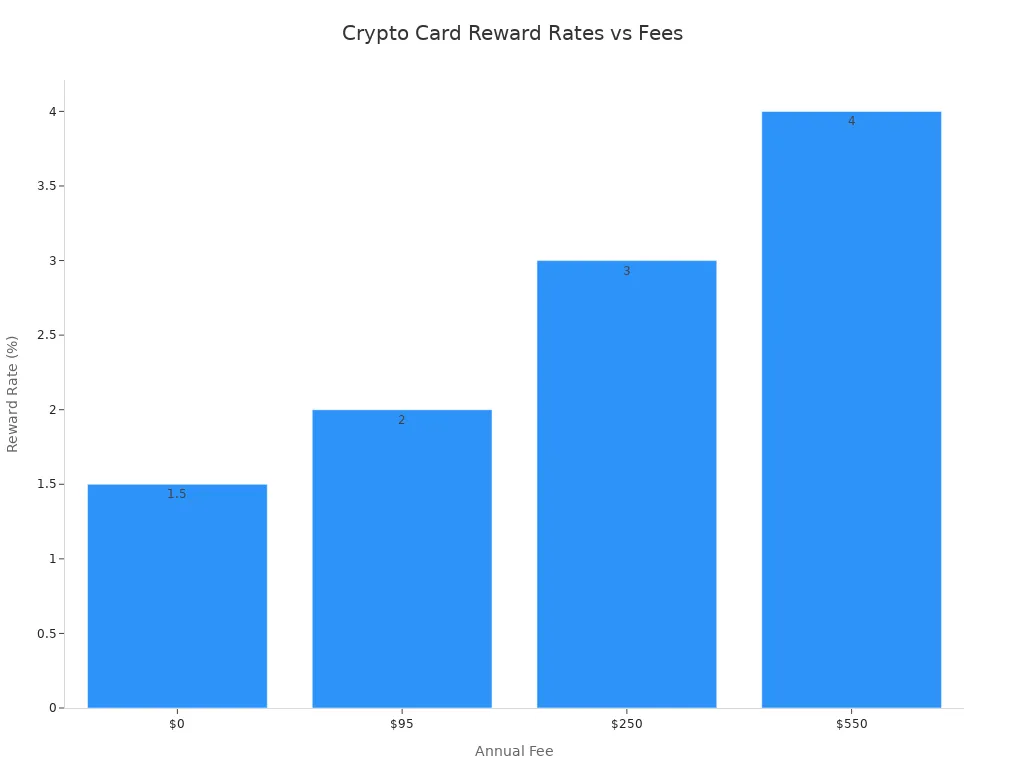
You should also consider breakeven points. For example, a card with a $95 annual fee and 2% rewards requires you to spend $4,750 per year to cover the fee with rewards. Higher annual fees demand even more spending to break even.
Tip: Always check both the headline reward rate and the real-world effective rate after fees. This helps you avoid surprises and maximize your crypto rewards.
UUPAY vs. Best Crypto Cards
UUPAY positions itself as a flexible option for users who want to control their crypto card fees. You can choose from a basic plan with no annual fee or upgrade to premium tiers for more perks. UUPAY gives you free ATM withdrawals up to $400 per month, then charges a 2% fee. This structure matches or beats many competitors, especially if you withdraw cash often.
Nexo offers no annual fees and free ATM withdrawals based on your loyalty tier. After you use your free quota, you pay a 2% fee. Coca and Coinbase also keep annual fees at zero and provide free ATM withdrawals up to a limit, making them strong choices for users who want to minimize costs.
Reward rates play a big role in your decision. UUPAY offers competitive rewards, especially at higher tiers. Nexo and other top crypto credit cards provide similar rates, but you need to check if staking or holding tokens is required to unlock the best rewards. Some cards, like Brighty and Cypher, charge higher annual fees for premium rewards, so you need to calculate if your spending justifies the extra cost.
You should also watch for hidden crypto card fees, such as foreign transaction charges, swap fees, and APRs on balances. These can add up quickly and reduce the value of your rewards. In 2026, foreign transaction fees average around 1.5%, and swap fees start at 1%. APRs can reach up to 29.99% if you carry a balance.
To sum up, you have many choices when it comes to crypto cards. If you want the lowest crypto card fees, look for cards with no annual fees and free ATM withdrawals. If you want higher rewards, check the breakeven spend and make sure you can reach it. UUPAY stands out for its flexible fee structure and strong rewards, making it a solid benchmark for comparison.
Types of Crypto Card Fees
Annual & Monthly Fees
You will notice that annual fees can range from zero to over a thousand dollars on crypto cards. Some crypto credit cards offer no annual fees, while premium options charge higher amounts for extra perks. Monthly fees are rare, but you should always check the card’s terms. High annual fees only make sense if you use the benefits often. If you do not spend enough, these fees can eat into your rewards.
Foreign Transaction Fees
Foreign transaction fees apply when you use your crypto cards abroad or make purchases in another currency. Most cards charge around 1.5%. These transaction fees can add up quickly if you travel or shop internationally. Always check if your card waives these fees for certain spending levels or premium tiers.
ATM Withdrawal Fees
ATM withdrawal fees vary by card. Some crypto credit cards give you free withdrawals up to a limit, then charge a percentage or flat fee. For example, you might get $400 per month free, then pay 2% after that. If you use cash often, these fees can impact your total costs.
Crypto-to-Fiat Swap Fees
When you spend with crypto cards, the provider converts your crypto to fiat. Swap fees usually start at 1%. Here is a quick look at leading cards:
Crypto Card | Fee Structure |
|---|---|
Bitget Wallet Card | No recurring fees; refunds FX fees within a quota; standard fees of 1%-2.2% post-quota. |
Brighty | FX fees starting from 0.3%; free exchanges up to 5,000 EUR with Pro plan, 2,000 EUR with Plus. |
You should watch these fees, as they can reduce your rewards.
APR and Interest Charges
If you carry a balance, you pay interest. Crypto credit cards have APRs that can reach 29.99%. For example:
Credit Card | Regular APR | Annual Fee | Welcome Bonus |
|---|---|---|---|
18.49% - 34.49% variable | $0 | N/A |
Paying off your balance each month helps you avoid these high charges.
Hidden Costs
Hidden costs include reward conversion spreads, inactivity fees, or card replacement charges. These fees may not appear in the main pricing table. Always read the fine print before you choose a card.
Tip: Review all fee types before you pick a crypto card. Small transaction fees and annual fees can make a big difference over time.
Reviews of Leading Crypto Credit Cards
UUPAY Fee & Reward Analysis
You can now access UUPAY’s upgraded platform at uupay.com. New users open a virtual card for only 1U and receive 1U back. All users enjoy zero card recharge fees, which helps you save money every time you add funds. UUPAY holds a US MSB license, registers in Hong Kong, and has a Swiss license. A Brazil license is pending. These credentials show strong compliance and security.
UUPAY offers flexible plans. You choose from a free basic card or premium tiers with higher rewards. The highest rewards rate reaches up to 4% for top-tier users. You also benefit from a referral program. If you invite friends, you can earn up to 50% commission on their fees. For example, if you spend $1,000 per month, you pay no annual fee and earn up to $40 in rewards at the highest rewards rate.
Tip: Take advantage of the 1U promotion and zero recharge fees to maximize your first-year value.
Nexo Card Fee & Reward Analysis
Nexo stands out among crypto credit cards for its zero annual fee and flexible reward structure. You get free ATM withdrawals based on your loyalty tier. After you use your free quota, you pay a 2% fee. Nexo’s highest rewards rate reaches 2% in crypto or 0.5% in fiat. You do not need to stake tokens for the base card, but higher rewards require holding NEXO tokens.
Suppose you spend $500 per month and withdraw cash twice. You pay no annual fee and earn $10 to $12 in rewards each year. If you hold more NEXO tokens, you unlock higher rewards.
Coca Card Fee & Reward Analysis
Coca ranks as one of the best crypto cards for travelers. You pay no annual fee and enjoy free ATM withdrawals up to $200 monthly. Coca offers a highest rewards rate of 1.5% on all purchases. You do not need to stake tokens or pay hidden fees. If you travel often, you avoid foreign transaction fees and maximize your rewards.
For example, if you spend $3,000 per year, you earn $45 in rewards with no extra costs. This makes Coca a strong choice for users who want simple, low-cost crypto credit card options.
Calculating True Costs & Rewards
Hidden Fees Impact
You need to look beyond the obvious costs when you use crypto credit cards. Comprehensive fees include not only annual charges but also hidden costs like swap fees, foreign transaction fees, and inactivity penalties. These fees can reduce your earnings from a rewards program. For example, if you pay a 1.5% foreign transaction fee and a 1% swap fee on every purchase, your total comprehensive fees can quickly add up. Always check the card’s terms so you do not lose value while earning crypto.
Reward Breakeven Points
You should calculate how much you need to spend to cover your card’s annual fee with rewards. This is your breakeven point. If your card charges $100 per year and offers a 2% rewards program, you must spend $5,000 to earn rewards that offset the fee. Cards with higher comprehensive fees require even more everyday spending to break even. Use this calculation to see if a card’s rewards program fits your spending habits and helps you earn rewards efficiently.
Everyday Spending Scenarios
Let’s look at how comprehensive fees and rewards programs affect your daily life. If you spend $1,000 each month on everyday spending, you could earn rewards worth $10 to $40, depending on your card’s rate and fees. However, if you pay high comprehensive fees, your net rewards shrink. To maximize earning crypto, choose a card with low fees and a strong rewards program. This way, you can earn rewards on every purchase and make your everyday spending work for you.
Best Crypto Cards for Different Users

Lowest Fees Winner
You want to save money on fees. The Bitget Wallet Card stands out in the crypto card market for lowest fees. You pay a comprehensive fee of only 1.7%. You do not pay top-up or conversion fees. Many users choose this card because it is one of the most cost-efficient options among current crypto cards. If you want to keep costs low, this card gives you a clear advantage.
Bitget Wallet Card: 1.7% total fee, 0% top-up, 0% conversion
Best for Travelers
If you travel often, you need top crypto cards that help you avoid extra charges. Coca and Coinbase offer free ATM withdrawals up to a set limit. You do not pay foreign transaction fees with Coca. These features make both cards strong choices for travelers. You can use these crypto debit cards worldwide and keep more of your money.
Coca: No annual fee, free ATM withdrawals up to $200/month, no FX fees
Coinbase: No annual fee, free ATM withdrawals (operator fees may apply)
Best for High Spenders
High spenders need top crypto cards with high cashback rates and valuable perks. UUPAY gives you flexible plans and high rewards. You can choose premium tiers for better cashback conversion cards and higher bonus rates. If you spend a lot, you can earn up to 4% in rewards and unlock extra bonus features. UUPAY’s structure helps you maximize value as your spending grows.
UUPAY: Up to 4% rewards, premium perks, flexible plans
Best for Crypto Rewards
You want to focus on earning cryptocurrency rewards. Top crypto cards like Nexo and UUPAY offer strong reward programs. Nexo gives you up to 2% back in crypto. UUPAY lets you earn up to 4% with premium tiers. Both cards support cashback conversion cards and offer bonus rewards for referrals. You can boost your earnings by choosing the right plan and using bonus offers.
Nexo: Up to 2% crypto rewards, no annual fee, bonus for loyalty
UUPAY: Up to 4% rewards, referral bonus, flexible plans
Tip: Compare top crypto cards based on your spending style. Look for the lowest fees, best cashback rates, and bonus features to get the most from your card.
You find that crypto credit cards with low fees and clear terms help you save more when you spend with the card. Always compare credit card rewards and fee structures. UUPAY stands out for flexibility and strong value. Choose the best card for your needs and make smarter financial decisions.
FAQ
What is an annual fee, and why do crypto cards charge it?
You pay an annual fee to keep your crypto card active. Some cards use the annual fee to cover rewards, security, and customer support.
How can you avoid paying a high annual fee on your crypto card?
You can choose a card with no annual fee or select a basic plan. Some cards waive the annual fee if you meet spending requirements.
Do crypto cards offer a welcome bonus, and how does it work?
You may get a welcome bonus when you sign up. The welcome bonus usually appears after you spend a set amount or pay the annual fee.
Note: Always check if the annual fee changes after the first year. Some cards increase the annual fee or remove the welcome bonus later.
You should compare the annual fee, welcome bonus, and rewards before you choose a card.
Some cards offer a low annual fee but fewer perks.
See Also
Best Low-Fee Crypto Cards to Use in 2026
Comparative Review of 2026's Best Crypto Payment Cards
Evaluating USDC Payment Cards Against Top Crypto Options
