Crypto card for private banking alternative
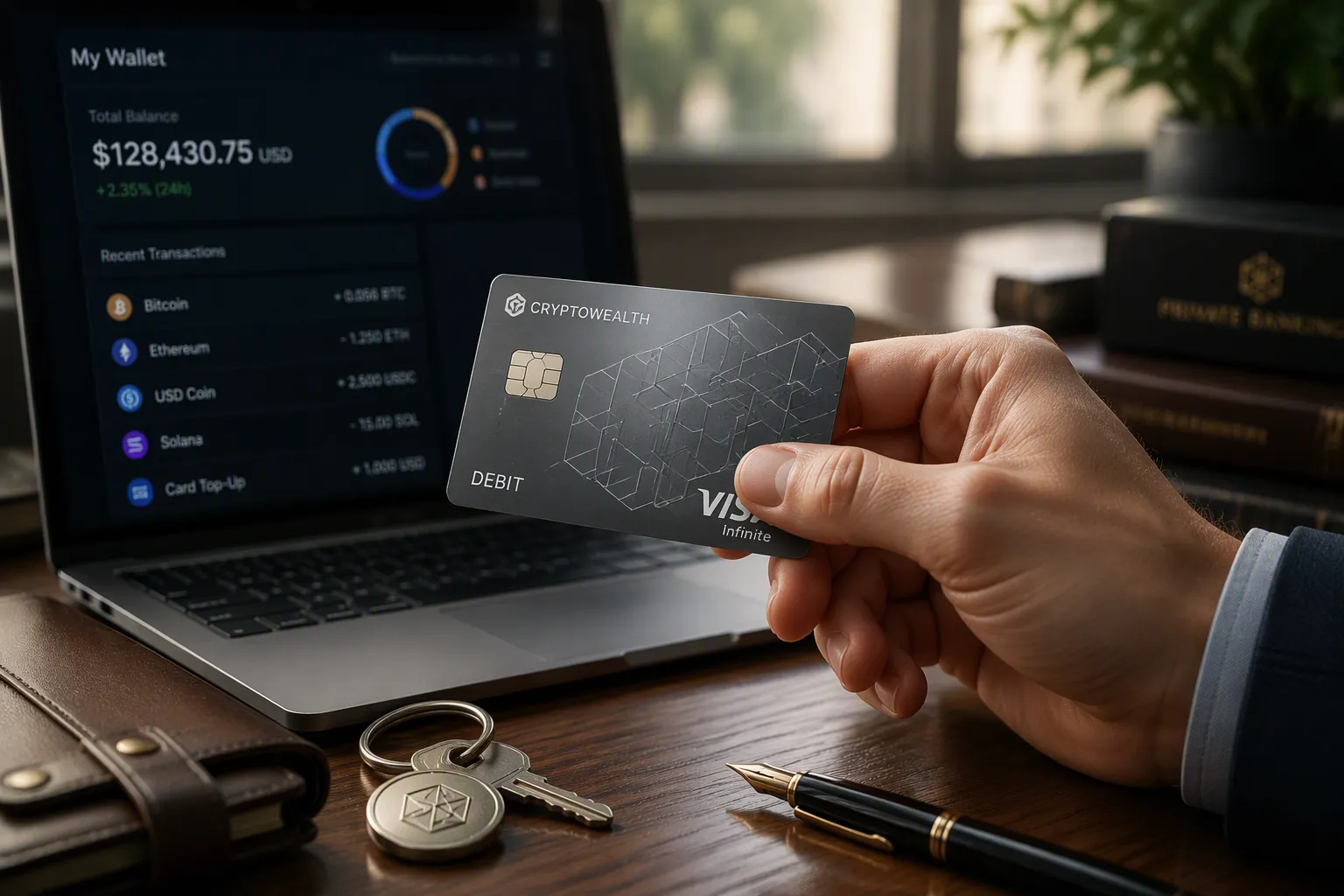
Yes, a Crypto card can replace private banking for everyday spending, liquidity, and asset control—not for full wealth management—if you accept its risks. You gain speed, lower fees, and custody. You lose relationship managers and personalized advice. Choose this path only if you value control and efficiency over traditional banking perks.
Key Takeaways
A crypto card gives you fast spending and low fees. You control your digital assets until you spend them.
You lose personalized advice and a safety net. A crypto card does not manage your long-term wealth.
Use a crypto card for daily spending and cross-border payments. Keep a private bank for wealth management and protection.
What Is a Crypto Card and Why It Matters
A Payment Card That Spends Digital Assets
A crypto card works like a debit or credit card at the checkout counter. You fund it with digital assets like Bitcoin or stablecoins. The card converts your crypto into traditional currency the moment you pay. This process is called instant conversion. You do not need to sell your crypto manually or wait for a bank transfer.
Custody means who holds your assets. With a crypto card, you often keep control of your funds until you spend them. Settlement refers to how the transaction finalizes between parties. Crypto settlement can happen in seconds on a blockchain. Traditional bank settlement may take days.
Mastercard's crypto card program shows how this works globally. Your crypto payment converts into traditional currency behind the scenes. Merchants accept the card anywhere Mastercard is accepted. In 2026, crypto cards come in three main forms: prepaid cards, virtual cards, and Mastercard-linked cards. Each form suits different spending habits.
Why It Competes With Private Banking
Private banking offers personalized wealth management. You get a dedicated relationship manager. That person helps with investments, estate planning, and tax strategies. A crypto card does not replace those services. It competes on spending, liquidity, and asset control instead.
You direct your own financial moves with a crypto card. No manager approves your transactions. No minimum balance sits in a low-yield account. You access your funds around the clock. This self-directed model appeals to people who want speed and independence.
The trade-off is real. You gain efficiency and lower fees. You lose tailored advice and a human safety net. A crypto card fits your daily spending needs. It does not manage your long-term wealth strategy.
How Crypto Cards Work vs. Private Banking

Settlement, Custody, and Access Compared
Private banking and crypto cards solve different problems. A private bank holds your assets in a custodial account. The bank controls settlement through traditional rails. Wire transfers may take one to three business days. Your relationship manager coordinates access during business hours. You rely on the bank's infrastructure and its schedule.
A crypto card flips this model. You keep custody of your digital assets until you spend them. Settlement happens on a blockchain in seconds or minutes. You access funds around the clock, every day of the year. No manager approves your transactions. No banking hours restrict your moves.
Feature | Private Banking | Crypto Card |
|---|---|---|
Custody | Bank holds assets | You hold assets until spend |
Settlement | 1-3 business days | Seconds to minutes |
Access | Business hours, manager-gated | 24/7, self-directed |
Advice | Dedicated relationship manager | None |
The relationship-manager model delivers personalized guidance. Your manager knows your family, your goals, and your tax situation. That human element carries real value for complex wealth planning. The self-directed crypto card model delivers speed and independence instead. You trade tailored advice for direct control. Neither model wins outright. Your priorities decide which trade-off makes sense.
Where UUPAY Fits in the Stack
UUPAY bridges custody and settlement in a way that mirrors private banking convenience without the gatekeeping. New users open a virtual card for 1U and receive 1U cashback. All users enjoy free top-up fees. The physical card now launches with global spending, so you can use it anywhere major networks are accepted. Cashback reaches up to 50%, which beats most traditional rewards programs.
Security and instant settlement sit at the core. UUPAY holds a US MSB license, Hong Kong registration, and a Swiss license. A Brazil license is pending. The platform also carries PCIDSS Level 1 certification, the highest standard for payment data security. Support runs 24/7 across the globe.
The referral program rewards you for inviting friends. Each successful invitation raises your commission level, climbing as high as 50%. This structure suits self-directed users who want their network to work for them.
Compare this to private banking. A private bank assigns you a manager and charges management fees. UUPAY gives you a crypto card, instant settlement, and compliance credentials without the relationship-manager overhead. You lose personalized wealth advice. You gain speed, lower costs, and direct control. That trade-off defines the choice.
Key Benefits Over Private Banking
Lower Fees and Instant Settlement
Private banks charge for almost everything. You pay account maintenance fees, custody fees, and wire transfer charges. You also pay a currency exchange spread on every international transaction. A Crypto card removes most of these layers. You fund the card with stablecoins. You pay at the terminal. The card converts only the exact amount of your purchase into dollars, euros, or local currency. Settlement finalizes on the blockchain in seconds. You see the deduction in real time.
Wirex built its entire model around this speed. Its instant-conversion stablecoin card lets you spend USDC or USDT anywhere Mastercard is accepted. You track every transaction the moment it happens. No bank officer reviews your payment. No clearing delay ties up your funds for three business days. The card converts crypto to fiat automatically at the point of sale. You hold your asset until the exact second of payment. That speed replaces the old waiting game.
That efficiency changes how you manage daily cash flow. You can keep funds in stablecoins, earn yield where available, and convert only what you need when you need it. Traditional private banking demands idle cash in low-yield accounts. The card lets your money keep working until you spend it. You do pay some costs—a conversion spread and possible ATM fees. Those costs stay far below typical banking overhead for active users.
Global Access and Self-Custody
The card works anywhere the payment network operates. You hold custody of your assets until the moment of spend. No bank can freeze your balance during a compliance review. No manager can block a transfer because it falls outside policy. This model suits people who move money across borders without asking permission.
Bitsa serves freelancers and digital nomads with a prepaid card that requires no bank account. You load the card, spend in local currency, and keep control of the underlying crypto. You still get a functional spending tool without a traditional banking relationship. Kripicard extends the same idea with instant virtual cards funded by USDT. You create a card for a digital subscription and fund it only when needed. The provider holds no ongoing access to your wealth.
These benefits come with a clear trade-off. You gain speed, lower fees, and direct control. You lose the relationship manager who plans taxes, structures estates, and rebalances portfolios. You also lose the traditional fraud protection and chargeback safety net. A Crypto card works for spending and liquidity. It does not handle long-term wealth strategy. That exchange makes sense for self-directed users. Anyone seeking a full private bank replacement will not find it here.
Risks and Limitations to Weigh
Volatility, Regulation, and Acceptance
You face three hard risks when you use a crypto card for spending. Regulatory treatment shifts without warning. A token may become classified as a security. Stablecoin rules remain unsettled. These changes can freeze your card program overnight.
Risk category | What it means for you |
|---|---|
Regulatory | Inconsistent rules, possible security treatment, stablecoin uncertainty |
Volatility | Rapid losses in spending power, unpredictable settlement values |
Merchant acceptance | Weak global acceptance, chicken-and-egg adoption problem |
Volatility cuts both ways. You may avoid spending an asset that keeps rising. Merchants dislike accepting an asset that keeps falling. Settlement values become unpredictable for both sides. Extreme price swings can wipe out the entire value of a crypto holding. That risk directly hits your card's spending power.
Merchant acceptance stays uneven. Many global marketplaces still show weak demand for crypto payments. The chicken-and-egg problem limits where your card works reliably. You cannot assume every terminal accepts it.
No Relationship Manager, No Safety Net
A private bank gives you a person to call. That manager handles fraud disputes, chargebacks, and compliance reviews. A crypto card gives you no such safety net. You resolve problems through support tickets. You absorb losses from failed transactions.
OffshoreCorpTalk's 2026 guide warns that no-KYC crypto cards often fail. Compliance pressure and reliability problems kill these programs. Reddit discussions on non-KYC cards reveal the same tension. Users want privacy. They also report frozen funds and dead support channels. That trade-off demands honest weighing.
You gain control and speed. You lose recourse when something breaks. Never treat a crypto card as a full private banking replacement. It handles spending and liquidity. It does not protect you from regulatory shifts, market crashes, or merchant rejection.
Who Should Use a Crypto Card
Strong Fits and Poor Fits
You fit this model if you earn, hold, or move digital assets across borders. BankStore.ai positions itself as private banking modernized for crypto and cross-border investors. That framing captures the core audience. You want fast settlement, low fees, and direct custody. You accept regulatory uncertainty as a cost of doing business. Freelancers paid in stablecoins, remote workers, and frequent travelers all match this profile.
You do not fit if you need estate planning, tax structuring, or discretionary portfolio management. A crypto card handles spending and liquidity. It does not build a wealth strategy. Retirees drawing from diversified portfolios, families with complex trusts, and anyone who wants a human to call during a dispute should stay with a private bank. The card fails you there.
When to Keep Both Options
Keep both when your needs split across two lanes. Use a crypto card for daily spending, cross-border payments, and quick access to stablecoin balances. Keep a private bank for long-term wealth management, estate planning, and the safety net of chargebacks and fraud protection. This pairing covers your short-term efficiency and your long-term security.
A crypto card supplements wealth management. It never fully replaces it. You gain speed and control on one side. You retain advice and recourse on the other. That balance protects you from the gaps each option leaves open. Match the card to your spending habits and custody preferences. Keep the bank for everything the card cannot do.
How to Choose the Right Crypto Card
Fees, Custody, and Card Limits
Start with the fee structure. MetaMask's 2026 guide compares crypto cards across rewards, fees, supported assets, custody models, and regional availability. You should run the same comparison yourself. Check the annual cost, the transaction fee, and the foreign exchange spread. A card with high cashback may hide steep conversion fees. A low-fee card may cap your monthly spending.
Custody decides who controls your funds. Some issuers hold your assets in a custodial account. Others let you keep self-custody until you spend. Self-custody gives you control. It also gives you full responsibility for security. Match the custody model to your comfort level. If you want a safety net, choose a regulated issuer with clear recourse policies.
Supported Assets and Security
Check which assets the card supports before you commit. USDC and USDT are the stablecoins most issuers reward and accept. Some cards let you convert other crypto rewards into stablecoins. A card that supports only one asset limits your flexibility. A card that supports many gives you more spending options.
Security features separate reliable cards from risky ones. Enable two-factor authentication on every account. Use a unique password. Keep unused funds in cold storage. Never share your passwords, private keys, or recovery phrases. Choose an issuer with strong regulatory oversight. Cryptocards.so ranks cards by cashback rewards, transaction fees, and annual costs. Use those rankings as a starting point, not a final answer.
Match the card to your spending habits, custody preferences, and tolerance for regulatory uncertainty. A crypto card works best when it fits how you already spend. It will not fix a weak financial plan.
Choose a crypto card when control and efficiency matter more to you than traditional banking perks. Treat it as a tool, never a strategy. Build a clear risk-management plan first. Then match the card to your spending habits, custody preferences, and tolerance for regulatory uncertainty.
FAQ
Does a crypto card fully replace private banking?
No. You gain spending speed, lower fees, and direct custody. You lose wealth management, estate planning, and a relationship manager. Treat it as a supplement, not a full replacement.
What happens when a transaction fails or funds freeze?
You resolve issues through support tickets. You absorb losses without chargeback protection. Choose regulated issuers with clear recourse policies. Never rely on a crypto card as your only safety net.
Who should avoid a crypto card?
Skip it if you need tax structuring, discretionary portfolio management, or a human to call during disputes. Retirees, families with trusts, and anyone wanting fraud protection should stay with a private bank.
See Also
Simple Strategies For Using Crypto Cards In Daily Purchases
KYC And No KYC Crypto Cards Privacy Versus Security Tradeoffs
Ranking Top Crypto Cards For Seamless Daily Purchases And Spending
UUPAY Manual For Multi-Currency Crypto Cards Designed For Unbanked Users
Introductory Guide Explaining Crypto Debit Cards For New Users
