Crypto debit card rewards: rates, caps, USDC options
You can earn up to 5% cashback with Crypto.com, but you must stake CRO tokens. UUPAY offers up to 2% crypto debit card rewards with no monthly caps and rewards in USDT, BTC, or ETH. UUPAY stands out for simple tiers, fee-free top-ups, and strong compliance, including US MSB licensing.
Key Takeaways
Crypto debit cards offer cashback rewards, allowing you to earn cryptocurrency back on your purchases. Rates vary by card and tier.
UUPAY stands out with unlimited rewards and no monthly caps, making it a great choice for frequent spenders.
Choosing stablecoin rewards like USDC can provide predictable value and reduce exposure to market volatility.
Crypto debit card rewards overview
How rewards work
Crypto debit card rewards let you earn perks every time you spend with your card. Each time you make a purchase, you can receive a percentage back in cryptocurrency. Most programs reward you with a set cashback rate, but the amount depends on your card and current offer. Many cards, like those from UUPAY or Ether.Fi, set different rates by card tier or require specific actions for the best rate.
💡 Before choosing a card, always review the terms. Some cards have minimum spending rules or monthly caps. The best way to maximize crypto debit card rewards is to understand your card’s structure and avoid missing benefits from unreviewed limits.
Types of rewards
Crypto debit card rewards come in several forms. Some cards pay you in mainstream cryptocurrencies, like Bitcoin or Ethereum. Others give you rewards in stablecoins, such as USDC or USDT. Stablecoins have prices that rarely change—they help you avoid price swings that may come with regular crypto.
If you get rewards in stablecoins, you deal with less volatility and fewer tax headaches from capital gains.
If you choose Bitcoin or Ethereum rewards, your returns could rise or fall after receiving them, depending on the market.
Some cards let you pick which type you want—flexibility can be useful if your risk tolerance changes.
Crypto debit card rewards can add up quickly for frequent spenders. Pay attention to reward rates and asset options so you can choose a card that fits your financial goals.
Reward rates comparison

Leading card rates (UUPAY, Crypto.com, others)
You want to know which cards offer the best crypto debit card rewards. The answer depends on the provider, your card tier, and sometimes the asset you choose for rewards. Here is a quick look at the current leading rates:
UUPAY: Up to 2% cashback on all spending. You do not need to stake tokens. UUPAY does not set monthly caps, so you can keep earning as you spend. New users can get a virtual card with no issuance fee and enjoy fee-free top-ups. UUPAY also stands out for its compliance: it holds a US MSB license, is registered in Hong Kong, has a Swiss license, is applying in Brazil, and meets PCIDSS Level 1 security. You get 24/7 support and can join a referral program that pays up to 50% commission for successful invitations.
Crypto.com: Up to 5% cashback, but only if you stake a large amount of CRO tokens. Lower tiers offer 1%-2% with less or no staking. Crypto.com sets monthly caps on rewards for some tiers.
Ether.Fi: Up to 3% cashback, but you must hold or stake their token. Some tiers have caps or require you to use specific assets for rewards.
Wirex: Up to 8% in WXT tokens, but only for the highest tier and with strict staking requirements. Most users get 0.5%-2% depending on their tier.
You can see that crypto debit card rewards often beat traditional card rates, but you must pay attention to the fine print. The table below compares crypto and traditional card rewards:
Type of Card | Reward Rate | Caps and Fees |
|---|---|---|
Traditional Cashback | 1.5% - 2% | Generally no extra fees, straightforward rewards. |
Crypto Debit Cards | Top-up fees, FX fees, and possible liquidation fees can reduce returns. Highest rates need staking and have monthly caps. |
📝 Tip: Always check if you need to stake tokens or meet other requirements to get the top rate. If you do not keep up with these, your rewards can drop.
Highest rates & special conditions
You might see some cards advertise up to 8% cashback, but these rates come with strict conditions. To get the highest crypto debit card rewards, you usually need to:
Stake or lock up a large amount of the card’s native token.
Maintain your staking for a set period. If you stop staking, your rate drops.
Stay within monthly or annual spending caps. If you go over, your cashback rate falls.
Choose the right asset for rewards. Some cards rotate which assets earn the highest rate.
For example, Crypto.com gives you up to 5% only if you stake a large amount of CRO. Wirex offers up to 8% in WXT, but you must stake a high amount and accept rewards in their token, which can be volatile. UUPAY keeps things simple: you get up to 2% with no staking and no monthly cap, and you can choose between USDT, BTC, or ETH for your rewards.
Card tiers play a big role. Higher tiers mean better rates, but you must meet tougher requirements. If you do not keep up with staking or holding tokens, your rewards can drop. Some cards also rotate which assets qualify for the best rates, so you need to stay updated.
Crypto debit card rewards can look much higher than traditional cards, but you must weigh the extra steps and risks. If you want the highest rates, you must be ready to lock up assets and watch for caps. If you prefer simplicity, look for cards like UUPAY that offer steady rates with fewer conditions.
Reward caps & limits
Common caps explained
You need to understand how caps affect your rewards. Most crypto debit cards set monthly or annual limits on how much cashback you can earn. These caps help card issuers control costs and encourage users to upgrade to higher tiers. For example, you might see a $25 or $50 monthly cap on lower-tier cards. Some premium cards offer much higher limits, such as $12,000 daily or $150,000 annually. Once you reach the cap, you stop earning rewards until the next period.
📝 Tip: Always check your card’s terms for cap details. If you spend more than the cap allows, you will not receive extra rewards for that period.
Caps by card (UUPAY vs. competitors)
Caps vary widely between providers. UUPAY stands out because it does not set monthly or annual caps on rewards. You can keep earning as you spend, which gives you more flexibility. Many competitors use strict caps, especially on lower tiers.
Here is a comparison of caps and requirements for popular cards:
Card/Tier | Monthly Cap | Annual Cap | Staking Requirement | |
|---|---|---|---|---|
UUPAY | Up to 2% | None | None | None |
Crypto.com Midnight | 1.5% CRO | $25 | $300 | None |
Crypto.com Ruby | 3.5% CRO | $50 | $600 | $500 CRO or $4.99/month |
Crypto.com Jade | 4.5% CRO | $100 | $1,200 | $5,000 CRO or $29.99/month |
Crypto.com Icy | 6% CRO | $500 | $6,000 | $50,000 CRO |
Crypto.com Obsidian | 6% CRO | $1,250 | $15,000 | $500,000 CRO |
Most cards increase caps as you move up tiers, but you must stake more tokens or pay higher fees.
UUPAY lets you earn unlimited rewards without staking or paying extra.
You should always compare caps before choosing a card. If you spend a lot, a card with no cap like UUPAY may suit you best.
USDC reward options
Cards with USDC rewards
You may want a card that pays rewards in stablecoins like USDC. This option gives you predictable value and avoids the ups and downs of regular crypto. Bitget Wallet Card stands out for offering USDC as a reward option. You only need to complete a successful KYC verification to qualify. After you finish KYC, you receive a 5 USDC bonus, which helps offset the opening fee. Bitget uses a stablecoin reward model, so your cashback stays steady. You can also stake USDC in the Bitget Wallet ecosystem and earn yields up to 8% APY.
Feature | Details |
|---|---|
Card Name | Bitget Wallet Card |
Reward Option | USDC |
Eligibility | Successful KYC verification |
Initial Bonus | 5 USDC bonus after KYC |
Cashback Model | Stablecoin reward model |
Additional Benefits | USDC staking yields up to 8% APY |
Other cards may offer rewards in USDT or other stablecoins, but USDC remains a popular choice for users who want stability.
USDC vs. crypto rewards
You need to understand the difference between USDC rewards and rewards in volatile cryptocurrencies. USDC rewards give you a stable value, so you avoid price swings. Volatile crypto rewards, like BTC or ETH, can change quickly and may lead to losses if prices drop. USDC also lets you earn passive income through staking or lending, with less risk than volatile crypto.
USDC maintains a stable value, reducing exposure to price fluctuations.
Volatile cryptocurrencies can experience significant price swings, leading to higher risk and potential losses.
USDC offers passive income opportunities through staking or lending, with lower associated risks compared to volatile cryptocurrencies.
If you prefer steady rewards and less risk, USDC is a strong option. If you want a chance at higher gains and can handle volatility, you might choose BTC or ETH rewards.
Pros & cons of reward structures
High rates & USDC advantages
You can benefit from high reward rates and stablecoin options in several ways. Many crypto debit cards offer cashback rates that far exceed traditional credit cards. Some premium tiers even reach double-digit percentages. You may also earn points for transactions, referrals, or simply staying active. If you choose USDC for your rewards, you avoid conversion fees and enjoy predictable value. The table below highlights the main advantages:
Feature | Description |
|---|---|
Cashback Rewards | Earn between 2-12% back on all spending, much higher than most credit cards. |
Points for Transactions | Get points for activity, transactions, and referrals. |
Zero Conversion Fees | Spend USDC with no conversion fees, unlike many crypto cards. |
Enhanced Rewards for Premium Tiers | Top-tier cards can offer up to 12% cashback, rewarding higher spending. |
USDC rewards give you stability. You know exactly how much you earn, and you can use or save your rewards without worrying about price swings.
Caps, volatility, and risks
You should also consider the drawbacks. Many cards set monthly or annual caps on rewards. These limits can reduce your total earnings, especially if you spend a lot. Some cards exclude certain merchants or categories, which can further lower your returns. If you earn rewards in volatile assets like Bitcoin or Ethereum, the value of your rewards can change quickly. This makes it harder to plan your finances. Staking requirements add another layer of risk. You may need to lock up tokens to get the best rates, and if the token price drops, your overall benefit decreases. Automated features like round-ups can help smooth out volatility, but the underlying risk remains.
🛑 Always review the terms and understand the risks before choosing a card. High rates look attractive, but caps, volatility, and staking can affect your real-world returns.
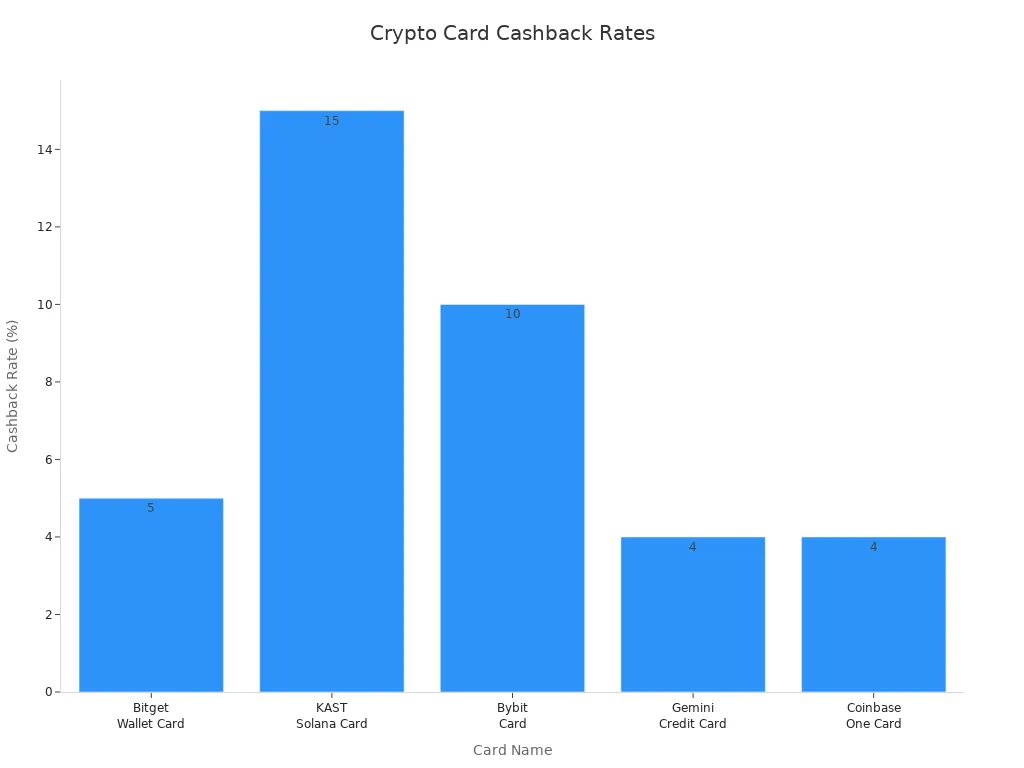
You should match your card choice to your needs. If you want high rates, KAST Solana Card and Bybit Card lead. For stable rewards, Bitget Wallet Card and Gemini Credit Card work well. UUPAY offers unlimited rewards and strong compliance. Review this table and chart to compare options:
Card Name | Cashback Rate | Stability | Flexibility |
|---|---|---|---|
Bitget Wallet Card | 5% (initial) | Stablecoin rewards | High (low fees) |
KAST Solana Card | Up to 15% | Variable | Moderate |
Bybit Card | Up to 10% | Variable | Moderate |
Gemini Credit Card | Up to 4% | Stable | High |
Coinbase One Card | Up to 4% | Stable | High |
Tip: Always check your spending patterns, fees, and card availability. Choose a card that fits your habits and risk level.
Factor | Description |
|---|---|
Spending Patterns | Evaluate which card's reward structure aligns best with your typical spending categories. |
Fee Analysis | Calculate the total cost of ownership, including annual fees, conversion fees, and ATM fees. |
Crypto Philosophy | Consider whether you prefer accumulating a specific cryptocurrency or want flexibility. |
Credit Requirements | Ensure you meet the credit score requirements to avoid unnecessary hard inquiries. |
Geographic Availability | Verify that your chosen card is available in your region and supports your local currency. |
FAQ
What makes UUPAY different from other crypto debit cards?
You get unlimited rewards, no monthly caps, and fee-free top-ups. UUPAY holds a US MSB license and offers 24/7 global support.
Can I earn stablecoin rewards like USDC or USDT?
Yes, some cards let you choose stablecoins for rewards. UUPAY offers USDT, while Bitget Wallet Card provides USDC rewards.
Do I need to stake tokens to get the best rates?
You do not need to stake tokens for UUPAY. Other cards, like Crypto.com, require staking to unlock higher cashback rates.
See Also
Evaluating USDC Payment Cards Against Top Crypto Card Choices
Choosing Between USDC Debit Cards And Other Crypto Options
Side By Side Comparison Of Crypto Visa Card Perks
