Crypto Card for Vietnamese Remote Workers Hired Abroad

The best crypto card for Vietnamese remote workers hired abroad comes down to four things: fees, VND conversion, spending limits, and compliance. UUPAY and other leading options each handle these differently. You earn a foreign salary, turn crypto into VND, and spend locally. This guide solves each problem, step by step, so you can pick a card with confidence.
Key Takeaways
Compare the total cost of using a crypto card, including hidden fees and exchange rates, to keep more of your salary.
Choose a card from a licensed provider with clear KYC rules to protect your money and stay compliant.
Test the card with a small purchase before you use it for your full salary to avoid surprises.
What Is a Crypto Card?
A crypto card is a payment card tied to a crypto wallet. You hold your balance in digital assets, and the card lets you spend that balance at ordinary merchants. The card network processes your purchase like any other card payment. The difference sits behind the scenes, where your crypto converts to local currency at the moment of sale.
How It Works for Remote Workers
You link the card to a wallet or exchange account during setup. When you tap or swipe at a store, the issuer checks your balance and converts the needed amount into VND. The merchant receives VND. You never handle a manual exchange for that purchase.
Think of it as a bridge between two worlds. Your salary arrives as crypto or USD. Your daily life runs on VND. The card closes that gap automatically, one transaction at a time. You can also top up the card balance in advance, which locks in a conversion rate before you spend.
Why Remote Workers Choose It
Remote workers choose this tool for speed and convenience. A crypto card removes the extra step of cashing out to a bank account before every purchase. Your funds stay in one place, and you spend directly from it.
The card also suits an irregular income. Freelancers and contractors often receive payment in crypto on varying dates. A card lets you spend what you have without waiting for a bank transfer to clear. Many issuers add app controls for freezing the card, setting limits, and tracking spending, which helps you manage a salary that arrives in a foreign currency.
Key Crypto Card Factors
Fees, Rates, and Limits
Fees decide how much of your salary survives the trip from wallet to merchant. Check three charges: the card issuance fee, the top-up or loading fee, and the foreign exchange spread applied at conversion. A card with a low headline fee can still cost more through a wide VND spread. Compare the total cost of one typical monthly spend, not the sticker price alone.
Limits matter just as much. Daily spending caps, ATM withdrawal ceilings, and monthly load limits all shape how you live on your salary. Pick limits that comfortably cover rent, groceries, and bills. UUPAY, for example, waives top-up fees for all users and offers a 1U card-opening deal for new users, which keeps entry costs low while you test the card.
Coins, Compliance, and Acceptance
Confirm the card supports the coins you actually receive. Some issuers accept only major stablecoins and Bitcoin. Others support a broader list. Match the card to your salary currency, or you will convert twice and pay twice.
Compliance protects your access. Look for a licensed issuer with clear KYC rules. UUPAY holds a US MSB license, Swiss and Canadian licenses through group companies, and a Hong Kong registration that meets Asian regulatory requirements. Merchant acceptance follows the card network, so check that Visa or Mastercard works where you shop.
Vietnam has no specific regulations on crypto transactions or digital-asset income yet. This creates real tax uncertainty for card users, so keep every record.
Top Crypto Cards Compared
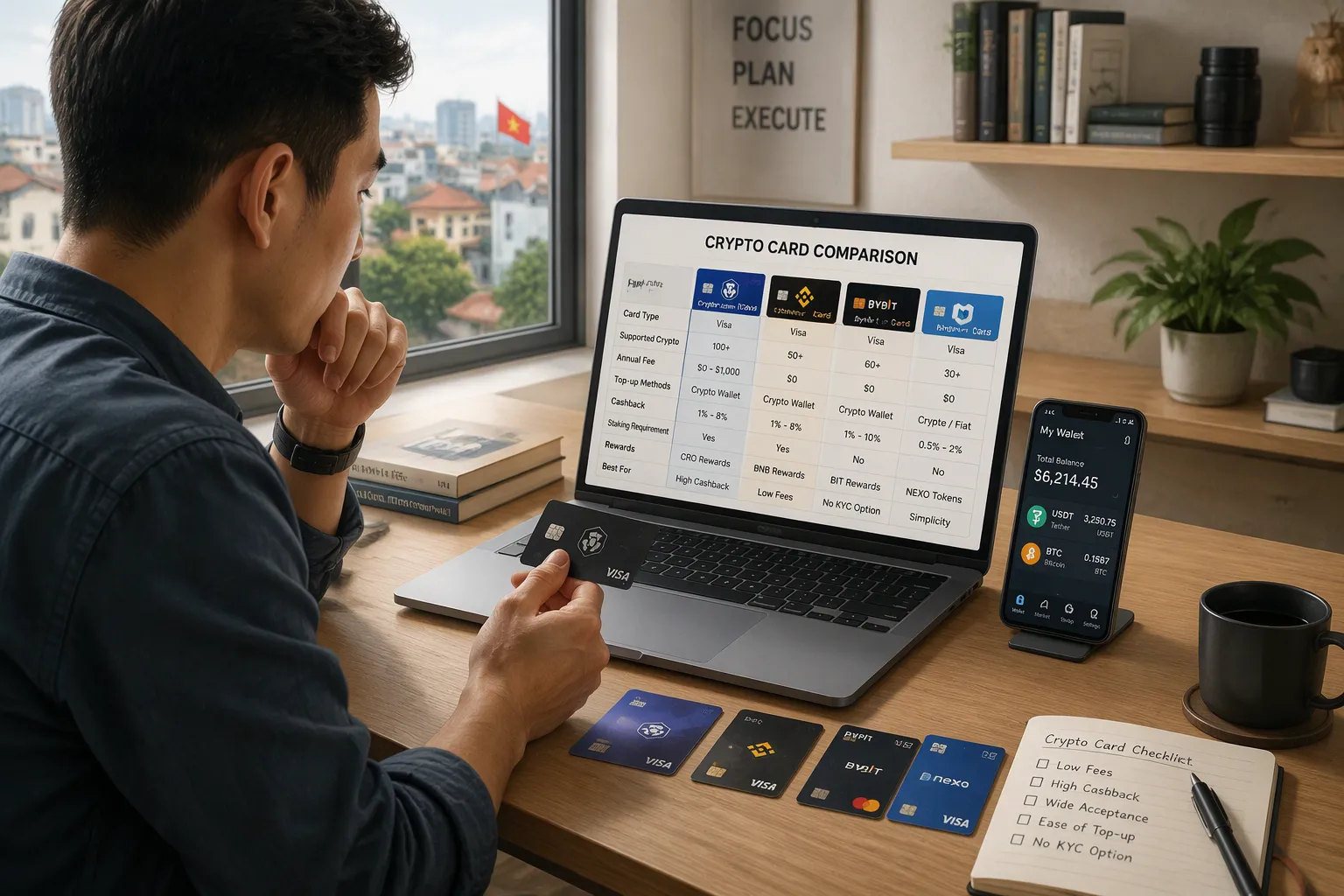
No single card wins for every worker. The right pick depends on how you earn, where you spend, and how much paperwork you can handle. This comparison weighs technical performance, application fit, regulatory compliance, and cost. Each option below suits a different profile. Every crypto card here earns its place for a specific reason.
Performance and Application Fit
Start with how well a card matches your actual routine. A worker paid in USDT wants a card that accepts USDT directly and converts to VND at checkout. A worker paid in Bitcoin wants broad coin support and a clean conversion path. Check app quality, settlement speed, and whether the card offers a virtual version for online bills and a physical version for local shops.
UUPAY fits workers who want a low-cost entry and a full service bundle. New users open a virtual card for 1U and receive 1U cashback. Top-up fees stay free for all users. The newly launched physical card works globally and offers up to 50% cashback. The app adds hotel and flight booking, eSIM, and chat support, which covers travel and connectivity in one place. A referral commission of up to 50% rewards users who bring colleagues onboard.
Other established cards fit different profiles. Some shine for workers who hold only major stablecoins and want a simple interface. Others suit heavy ATM users who need generous withdrawal ceilings. Match the card to your salary currency first, then compare the extras. Speed matters when rent is due.
Compliance and Cost
Compliance carries more weight in Vietnam than it did a year ago. Resolution No. 05/2025/NQ-CP established the country's first crypto exchange licensing regime. The Law on Digital Technology Industry, passed in June 2025, classifies digital assets as a type of property under the Civil Code, effective 1 January 2026, per PD Legal. The law lists two categories: virtual assets and encrypted assets. It excludes CBDCs, securities, and other financial assets that fall under separate regimes. The law does not name Bitcoin directly, yet Bitcoin falls under this property recognition as a digital asset.
UUPAY meets this bar with a US MSB license, Swiss and Canadian licenses through group companies, a Hong Kong registration, and a Brazil application in progress. It also holds PCIDSS Level 1 certification and runs 24/7 global support. Cost still decides the winner. Compare the FX spread on VND conversion, not just the headline fee. A card with free top-ups and a tight spread keeps more of your salary. Ask the issuer for a written fee schedule before you apply.
Getting and Using a Crypto Card
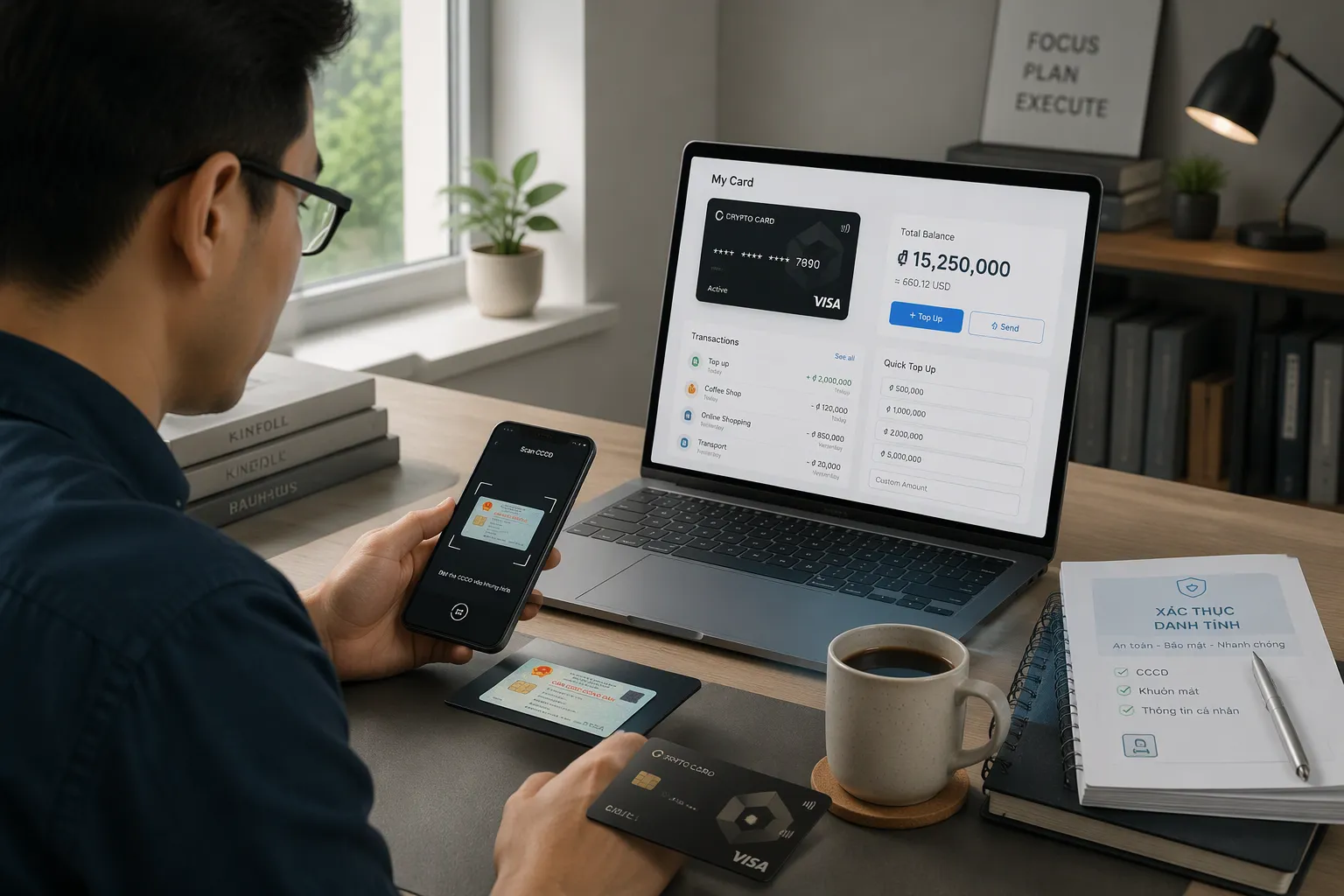
KYC and Approval
You start by creating an account and choosing a plan that fits your spending needs. Mastercard describes a simplified issuance flow for card programs. You then select a certified partner, which speeds up the process and keeps it transparent. Finally, you track your application progress across every step and every party involved.
Identity verification comes next. Vietnamese applicants complete KYC with a CCCD, the chip-based 12-digit biometric Citizen Identity Card. You photograph the card and scan the chip through the issuer's app. The system matches your face to the chip data. Approval usually follows once your documents clear. A licensed issuer such as UUPAY adds layers here: a US MSB license, PCIDSS Level 1 certification, and 24/7 global support. These checks protect your account and confirm the issuer meets regulatory standards.
Funding and Payments
You fund the card in several ways. If your employer pays in USD, you can receive those payments and cash out to VND or crypto through platforms such as TransFi Biz Pay. If you prefer to buy crypto with VND first, Banxa lets you do that directly. Both routes feed your card balance, and you spend from there.
Blockchain remittance offers a cheaper path for overseas workers. These solutions can save workers 6–9% in fees compared with traditional transfers, according to industry estimates. That saving compounds over a year of salary payments.
Once funded, your card works at any merchant on its network. You tap, swipe, or pay online, and the issuer converts your balance to VND at the point of sale. Set a top-up schedule that matches your pay cycle. Test with a small purchase first, then scale up. A well-funded crypto card turns your foreign salary into everyday spending without a bank in the middle.
Managing Crypto Salary and Spending
Budgeting and Recordkeeping
Treat your salary in three buckets: money for this month's bills, money held in stablecoins, and money you convert to VND. Convert only what you need for the near term. This habit smooths out price swings and stops you from selling at a bad moment. Set a fixed top-up day that matches your pay cycle, and keep a small buffer on the card for surprise expenses.
Record every conversion and every card purchase. Note the date, the amount, the coin, and the VND rate you received. Vietnam has no specific rules on digital-asset income yet, so a clean log protects you if the tax treatment changes. A simple spreadsheet works fine. Export your card statements monthly and store them with your payslips.
Staying Compliant
Know your residency status before you route salary through a crypto card. Foreign employees in Vietnam need a valid work permit and the correct visa class. The digital nomad visa route suits remote workers who serve overseas employers. Keep copies of your contract, your permit, and your visa with your financial records.
Watch the regulatory picture. Resolution No. 05/2025/NQ-CP created the first crypto exchange licensing regime, and the 2026 digital-asset law treats digital assets as property. Licensed issuers will adapt faster to new rules. Review your card provider's compliance status each year, and confirm your KYC details stay current.
The right crypto card balances low fees, fair VND conversion, suitable limits, and compliance with your own situation. Your next steps:
Shortlist two or three cards, UUPAY among them.
Verify KYC requirements and written fee schedules.
Test a small transaction before routing your full salary.
Treat salary management as an ongoing habit, and review your setup regularly.
FAQ
How much does it cost to open a UUPAY virtual card?
New users pay 1U to open a virtual card and get 1U back as cashback. Top-up fees stay free for all users.
Which document do you need for KYC in Vietnam?
You verify your identity with a CCCD, the chip-based 12-digit biometric Citizen Identity Card. The issuer's app scans the chip and matches your face to it.
Does a crypto card make your salary taxable in Vietnam?
Vietnam has no specific rules on digital-asset income yet. Keep records of every conversion and purchase, and review your provider's compliance status each year.
See Also
Virtual Crypto Cards Beginner Guide For Digital Nomads Paying Overseas Rent
Top Methods Using Virtual Crypto Cards For Vietnam International Flight Bookings
Using Multi-Currency Crypto Cards To Handle Thailand Cross-Border Purchases
Benefits Of Virtual Crypto Cards For Southeast Asia Marketplace Fee Payments
Choosing Thailand Crypto Cards For Smooth And Seamless Everyday Spending
