Crypto debit card regional availability and KYC requirements in 2026

You can instantly compare global issuers, regional coverage, and verification rules in this 2026 Crypto debit card matrix:
Issuer | Regions | Verification Tier | Key Documents Required |
|---|---|---|---|
UUPAY | US, EU, APAC, LATAM | Basic / Fast KYC | Government ID, Live Selfie |
Coinbase | US, UK, EU | Full Tier 1 | Passport / SSN, Proof of Address |
Bybit | APAC, LATAM, EU | Intermediate | Passport, Selfie |
You must submit a valid government photo ID, proof of address, and a biometric selfie to activate your Crypto debit card in 2026.
Key Takeaways
Card issuers require a government ID, address proof, and a selfie to activate your crypto debit card.
Licensed platforms like UUPAY offer instant virtual cards with global spending access and low fees.
Unverified cards enforce strict spending limits and freeze accounts quickly under global banking rules.
2026 Crypto Debit Card Regional Availability

Regulatory frameworks dictate where you can order and spend with a card in 2026. Localized financial licensing determines physical and virtual card delivery across global jurisdictions. Global regulatory oversight creates distinct operational environments between developed and emerging economies:
Region / Market | Regulatory Impact on Card Availability | Volume Effect |
|---|---|---|
United States & European Union | Stricter regulatory enforcement causes card volume to move toward compliant options or vanish. | Local card usage declines or transitions to regulated pathways. |
Emerging Markets | Regulatory enforcement lags, allowing crypto debit cards to continue functioning normally. | Card availability remains steady over the medium term. |
Global Market Overall | Regional restrictions are offset by continued usage in emerging economies. | The total impact on global card volume is less severe than headlines imply. |
North American Market and US SSN Rules
You face strict identity verification rules in the United States. Federal banking laws force all US card issuers to collect your full nine-digit Social Security Number (SSN) before activating your account.
American platforms must verify your residential address against credit bureau records. US issuers cannot issue physical or virtual cards without this mandatory data match.
💡 Compliance Note: Financial platforms like UUPAY secure active operations through proper licensing. UUPAY maintains a US Money Services Business (MSB) license, PCI DSS Level 1 certification, and 24/7 global support to ensure compliant service delivery across North American corridors.
European Union Access Under MiCA Standards
The European Union enforces full Markets in Crypto-Assets (MiCA) rules. You can access compliant card services only from licensed Electronic Money Institutions (EMIs) or regulated crypto asset service providers.
You can choose from several fully compliant card options in the EU market:
COCA Visa Card: Available in EU, UK, and Switzerland with 0% foreign exchange fees.
MetaMask Card: Available in EU, UK, and Switzerland with 0% foreign exchange fees.
Gnosis Pay Card: Available in EU, UK, and Switzerland with 0% foreign exchange fees.
WhiteBIT Nóva: Available in EU, UK, and Switzerland with 0% foreign exchange fees.
Trade Republic Card: Available in EU member states (excluding UK) with 0% foreign exchange fees.
Bitpanda Card: Available in EU member states (excluding UK) with 0% foreign exchange fees.
Bybit Card: Available in EU and Switzerland with a 0.5% foreign exchange fee.
Coinbase Card: Available in EU and UK with 0% foreign exchange fees.
Wirex Card: Available in EU and UK with 0% foreign exchange fees.
Revolut: Available in EU and UK with 0% foreign exchange fees.
Nexo Card: Available in EU and UK with 0% foreign exchange fees.
Deblock Card: Available in EU member states (excluding UK) with 0% foreign exchange fees.
Asia-Pacific Expansion and Regional Rules
Asia-Pacific regulators maintain varied local requirements. Financial authorities in Singapore and Hong Kong enforce strict anti-money laundering frameworks, but non-EU custodial options like Bybit expand across APAC by utilizing streamlined passport and selfie checks.
Regional licensing ensures system stability for cardholders. UUPAY registers its business in Hong Kong to fulfill Asian regional compliance standards while operating its subsidiary under a Swiss regulatory license. This strong regulatory foundation gives you reliable cross-border payment utility across Asia-Pacific economies.
Latin America and Emerging Markets Access
Latin American markets display rapid growth for digital asset payments. Enforcement timelines lag behind Western nations, so crypto debit card options continue operating steadily across emerging markets.
custodial platforms like Bybit rapidly expand in Brazil and surrounding nations using primary passport checks. UUPAY is currently applying for a localized Brazil license to expand its regional service footprint.
You can access competitive onboarding incentives when selecting modern virtual providers:
Low Entry Cost: UUPAY offers new users a virtual card for 1 USDT, plus a 1 USDT instant rebate upon activation.
Zero Deposit Fees: You pay zero card recharge fees across all supported digital assets.
Referral Rewards: You can earn up to 50% commission by inviting new users to the platform.
UUPAY Regional Availability and Virtual Solutions
UUPAY delivers accessible payment solutions across global markets through strong regulatory compliance. You can easily activate virtual cards to spend digital assets worldwide.
UUPAY Card Coverage Across Global Jurisdictions
UUPAY operates under strict international financial standards. Local financial authorities monitor UUPAY operations across key jurisdictions to ensure full platform transparency:
Region | Regulatory Framework / License Type | Governing Body / Standards |
|---|---|---|
Hong Kong | Money Service Operator (MSO) License | Hong Kong Customs & Excise Department |
Lithuania | Virtual Asset Service Provider (VASP) Framework | Operating under EU MiCA-aligned standards |
United States | Money Services Business (MSB) Registration | Financial Crimes Enforcement Network (FinCEN) |
Canada | Money Services Business (MSB) Registration | Financial Transactions and Reports Analysis Centre of Canada (FINTRAC) |
These licenses allow UUPAY to issue virtual cards across North America, Europe, Asia-Pacific, and Latin America. UUPAY also maintains a Swiss regulatory license and holds PCI DSS Level 1 certification to safeguard your transactional data.
Supported Fiat Off-Ramps and Digital Assets
You can quickly convert your crypto into instantly spendable fiat balances. UUPAY supports major digital assets, allowing direct payments through global payment networks.
⚡ Quick Onboarding: You can generate a new UUPAY virtual card for just 1 USDT and receive an instant 1 USDT cashback rebate upon account activation.
You enjoy user-friendly features when funding your card:
Zero Recharge Fees: You pay 0% fees on all digital asset deposits.
Continuous Assistance: You access 24/7 global support for instant troubleshooting.
Earn Opportunities: You can join the referral program to earn up to 50% commission tiers.
Global KYC Requirements for Crypto Debit Cards

Identity verification protects global financial networks from fraud. You must complete a standardized know-your-customer process before activating any card product in 2026.
Major payment card networks do not verify your identity directly or onboard crypto platforms. Instead, payment networks enforce compliance rules indirectly through issuing BIN sponsor banks. These sponsor banks retain full responsibility for anti-money laundering regulations while offering core card infrastructure.
Mandatory ID Documents and Biometric Checks
You must complete three distinct identity checks during onboarding. First, you must submit a valid government photo ID, such as a passport or a national identity card. Next, you must provide a proof of address document to verify your legal residence.
To fulfill address verification, your document must display your full name and residential address. Issuing authorities must create this document within the preceding three months:
Bank statements issued by a regulated banking institution
Utility bills covering electricity, gas, water, or home internet services
Mobile phone statements (these experience higher rejection rates compared to utility bills)
Finally, automated systems require a live biometric selfie scan. Facial recognition software compares your live biometric data against your photo ID. This automated process confirms your physical presence and prevents identity theft.
Instant Virtual Card Issuance Post-Verification
You gain access to your funds quickly once identity systems confirm your documents. Identity platforms verify valid documents in real time using optical character recognition.
Upon successful identity verification, algorithms generate virtual cards instantly for immediate online spending. You can link your virtual card to digital wallets like Apple Pay or Google Pay right away.
💡 Smart Onboarding: You can test modern virtual card issuance with UUPAY. UUPAY lets new users issue a virtual card for 1 USDT, and you receive an instant 1 USDT cashback rebate upon account activation. You also enjoy 0% recharge fees on all digital asset deposits.
FATF Travel Rule Compliance for Cardholders
Financial Task Force standards enforce strict data collection across cross-border transfers. Payment issuers must attach detailed identity metrics to card transactions.
The following table shows data requirements for card withdrawals under FATF rules:
Transaction Type | Required Transaction Information | Information Sharing Requirements |
|---|---|---|
Domestic Card Withdrawals | Account number or card number only | No additional data must accompany the transaction. |
International Card Withdrawals | Card number required | Cardholder name must reach the acquiring financial institution upon request within 3 business days. |
FATF regulations reshape digital payment systems through strict requirements:
Payment Chain Accountability: Standardized originator data rules require clear user tracking across all participating payment intermediaries.
Elimination of Non-KYC Models: Products supporting crypto debit card payments, withdrawals, or value transfers must verify user identities without exception.
Global Regulatory Alignment: Frameworks like Europe's MiCAR standardize identity attribution rules across international jurisdictions.
Centralized Exchange Cards versus Self-Custodial Cards
Centralized exchanges require full identity verification before offering physical or virtual cards. These custodial platforms hold your private keys and report account activity directly to local tax authorities. You trade personal privacy for higher spending limits and seamless fiat conversions.
Self-custodial card solutions let you maintain direct ownership of your digital wallet keys. Smart contracts lock your assets until you complete a transaction at a merchant terminal. However, modern self-custodial providers must still collect basic identity documents under global banking laws.
🔐 Compliant Security: Reliable issuers protect user assets by maintaining full regulatory authorization. UUPAY backs its global service with a US MSB license, a Swiss financial license, a Hong Kong MSO license, and a PCI DSS Level 1 security certification.
Low-KYC Realities and Privacy Limits
Some providers advertise low-verification card options in 2026. However, strict international anti-money laundering laws limit their global usefulness. These platforms impose tight operational constraints, daily spending caps, and sudden account blocks when you skip identity checks.
Spending Caps on Reduced-KYC Card Options
Minimal-verification card tiers restrict your purchasing power. Financial regulations force issuing banks to cap daily and annual spending for unverified accounts:
Card Name | No-KYC Monthly Limit | Annual Spending Allowance | Suitability for $5K/Mo Income |
|---|---|---|---|
Holyheld | ~€10,000 per day | ~€300,000 per year | Fully Capable |
KAST | ~$2,000 | ~$24,000 per year | Partial (Covers ~40%) |
ether.fi Cash | ~$1,000 | ~$12,000 per year | Insufficient |
Zypto | ~$250 prior to verification | ~$3,000 per year | Immediately triggers KYC |
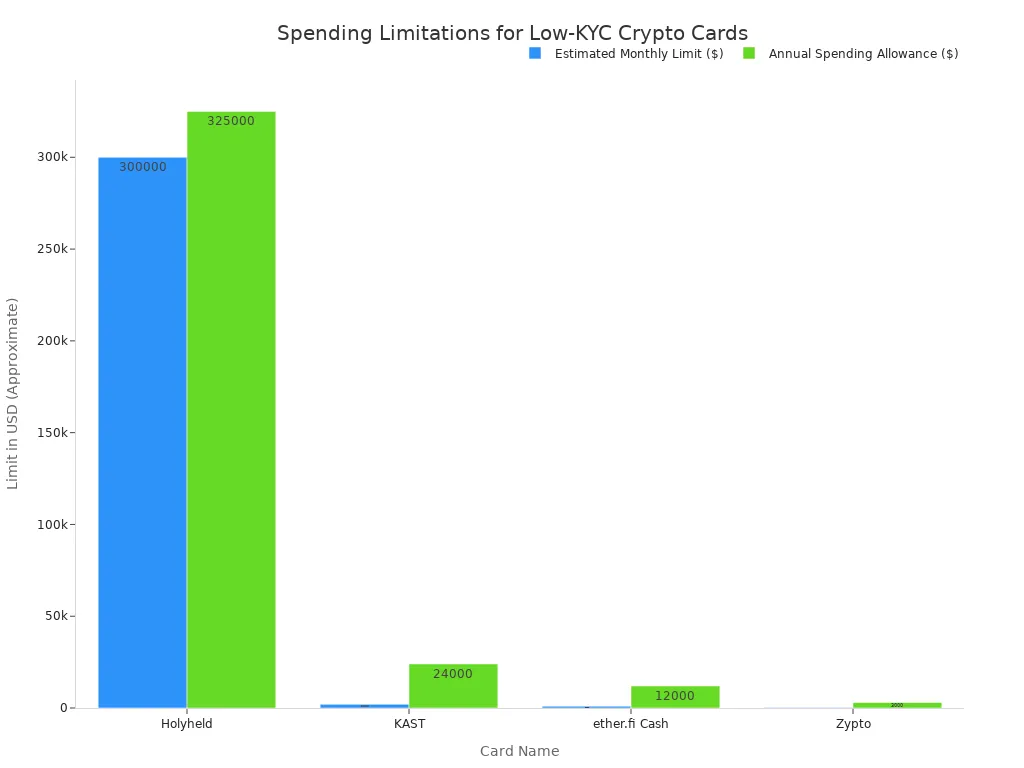
Low-tier Crypto debit card choices introduce severe practical hurdles:
Geographic Delivery Exclusions: Providers like Holyheld restrict physical card shipping exclusively to European Economic Area residents.
Progressive Verification Triggers: Systems automatically freeze low-KYC accounts when total transaction volume exceeds $1,000 under FATF Travel Rule requirements.
US Market Exclusions: US banking laws ban anonymous card issuance, blocking American users completely.
UUPAY Virtual Cards for Fast Onboarding
UUPAY balances fast digital onboarding with rigorous compliance. You can bypass slow paperwork while enjoying high regulatory security across global payment networks.
💡 Compliance Check: UUPAY maintains an active US MSB registration, PCI DSS Level 1 security, a Hong Kong MSO license, and a Swiss compliance framework. UUPAY is also expanding its reach through pending regulatory approval in Brazil.
You can set up a modern Crypto debit card through your smartphone in minutes. New users get a virtual card for 1 USDT and receive an instant 1 USDT cashback rebate. UUPAY also waives card recharge fees for all digital asset deposits, while offering up to 50% referral commissions.
Selecting the right Crypto debit card depends on your residence, compliance tolerance, and spending limits:
Full-KYC Exchange Cards: Choose these for maximum spending limits through full document verification.
Localized UUPAY Cards: Select these for rapid compliance onboarding, global flexibility, and low fees.
Self-Custodial Cards: Pick these for direct wallet ownership alongside basic identity checks.
FAQ
Can you get a crypto debit card without KYC in 2026?
You cannot get a fully functional card without verification in 2026. Low-KYC cards limit your daily spending heavily and block physical shipping in most regions.
What documents do you need to activate a card?
You must submit a valid government photo ID, a proof of address document issued within three months, and a live biometric selfie.
How fast can you receive a virtual crypto debit card?
You can receive a virtual card instantly after passing identity verification. Platforms like UUPAY issue virtual cards for 1 USDT with zero recharge fees.
See Also
Are You Prepared To Use Crypto Reloadable Cards In 2026
Discovering The Premier No ID Crypto Card For Year 2026
Three Essential Insights Regarding Malaysian Crypto Card Regulations In 2026
Simple Methods To Acquire Your Own Virtual Cryptocurrency Debit Card
Ultimate Crypto Card Handbook For International Sellers Paying Global Subscriptions
