U.S. crypto card fees for USD spending explained
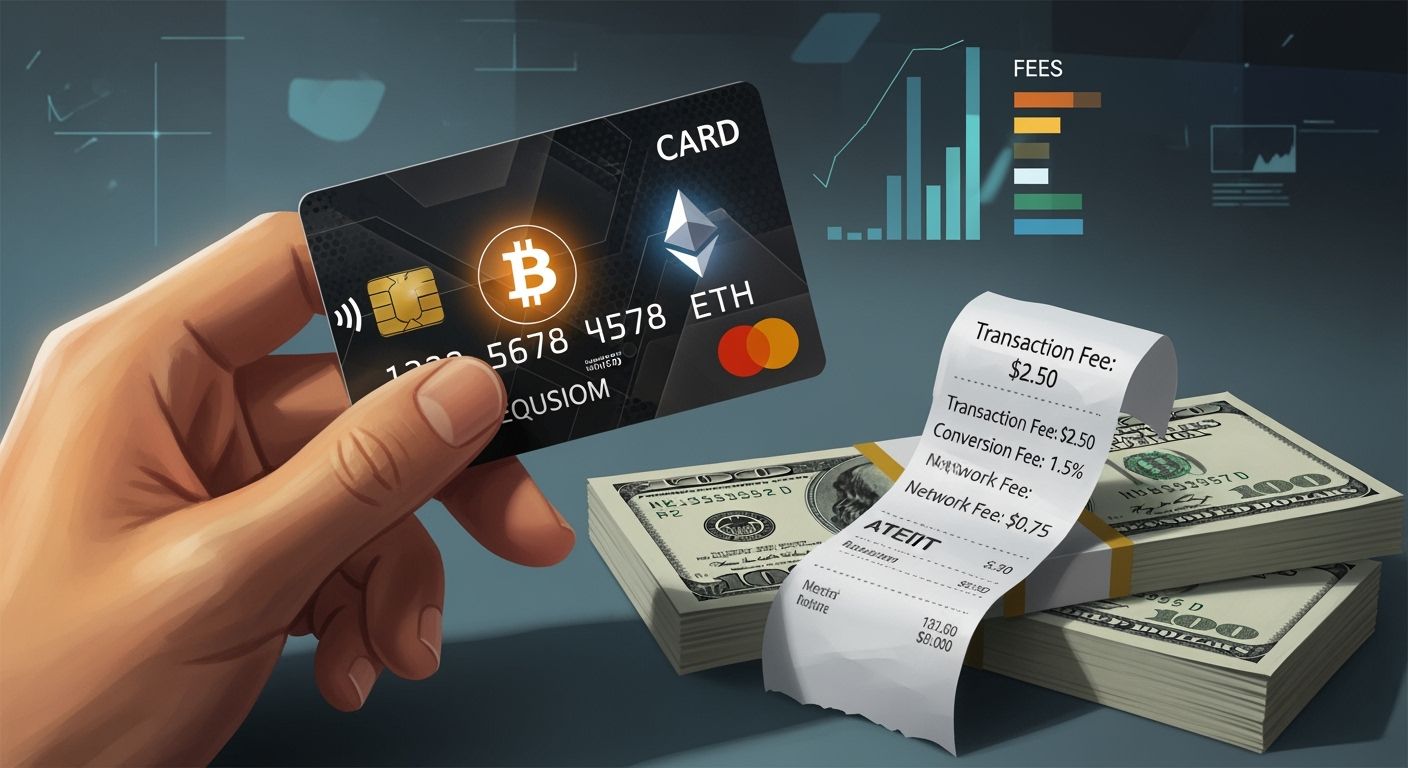
When you use a crypto card to spend USD in the U.S., you face several types of fees. These include activation, monthly maintenance, point-of-sale transaction, ATM withdrawal, and conversion fees. Each provider sets its own fee structure. For example, ATM withdrawal fees usually range from 1% to 3%. You should always check for hidden charges, as some providers add inactivity or replacement fees. Understanding crypto card fees helps you avoid surprises.
Key Takeaways
Understand the different types of crypto card fees, including conversion, transaction, and ATM withdrawal fees. This knowledge helps you avoid unexpected costs.
Always compare providers to find cards with transparent fee structures. Look for options with low or no monthly fees and rewards that can offset your expenses.
Regularly monitor your spending and review your statements for hidden fees. Staying alert can help you manage costs and maximize the benefits of your crypto card.
Overview of Crypto Card Fees
Main Fee Types
You encounter several main fee types when you use a crypto card for USD spending. These fees can affect your total costs and influence your spending decisions. Here is a quick look at the most common fee categories:
Fee Type | Description |
|---|---|
Conversion fees | Fees that apply when digital assets are converted during payment processing. |
Network-related fees | Fees associated with blockchain transactions, influenced by network activity. |
ATM or withdrawal-related fees | Fees incurred when withdrawing cash from ATMs using the crypto card. |
Foreign exchange-related costs | Costs arising from currency conversion differences during overseas spending. |
You may also see monthly maintenance fees, activation fees, or charges for card replacement. Each provider sets its own structure for crypto card fees, so you should always review the details before you start using a card.
Why Fees Matter
Crypto card fees directly impact how much you pay for each transaction. For example, stablecoin payments usually cost between 0.5% and 2%. Traditional bank transfers can cost more, ranging from 2% to 7%.
Payment Type | Cost Range |
|---|---|
Stablecoin Payments | 0.5-2% |
Traditional Bank Transfers | 2-7% |
If you understand these fee types, you can make smarter choices and avoid unnecessary expenses. You should compare providers and look for cards with transparent fee structures. Some cards offer lower fees for certain payment types, which helps you save money over time. Always check for hidden fees, as these can add up quickly and affect your budget.
Types of Crypto Card Fees

Conversion Fees
When you use a crypto card, conversion fees often apply. These fees cover the cost of converting your cryptocurrency into USD at the time of purchase. You may see a conversion spread, which is the difference between the market rate and the rate offered by your provider. Most providers charge between 1% and 2.5% for this service. Some cards add an extra spread, especially during periods of high market volatility. You should always check the conversion rate before making a transaction. This helps you avoid unexpected costs and better understand how crypto card fees affect your spending.
Tip: Compare conversion rates across providers. Even a small difference can impact your total expenses over time.
Transaction Fees
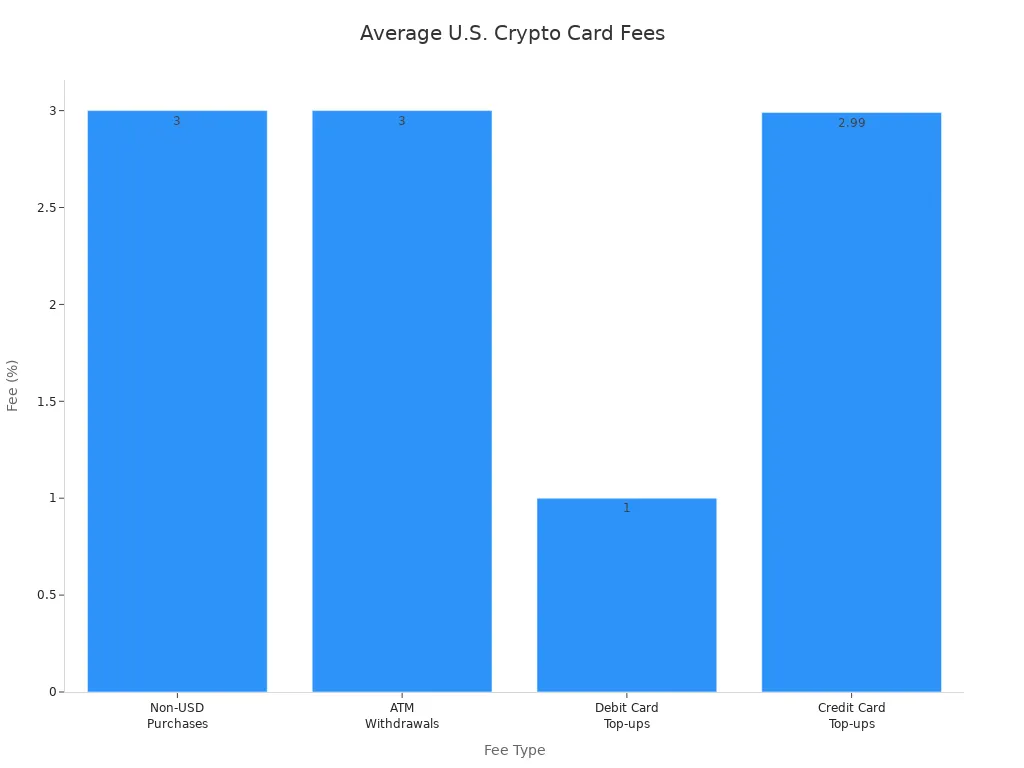
Transaction fees apply when you make purchases with your crypto card. These fees can vary based on the type of transaction and the provider. For U.S. crypto card purchases in USD, the average fees look like this:
Fee Type | Amount |
|---|---|
Non-USD Purchases | |
ATM Withdrawals | 3% |
Debit Card Top-ups | 1% |
Credit Card Top-ups | 2.99% |
You pay higher fees for non-USD purchases and ATM withdrawals. Debit card top-ups cost less than credit card top-ups. Providers may also charge a minimum fee per transaction, such as $1. Online purchases usually carry a fee between 2.25% and 2.50%, while in-person transactions tend to cost less.
Transaction Type | Average Fee Range |
|---|---|
Online Purchases | 2.25% - 2.50% |
In-Person Transactions | Lower than 2.25% |
You should review the fee schedule before using your card for different types of purchases. This helps you manage crypto card fees and avoid overspending.
ATM Withdrawal Fees
ATM withdrawal fees are a major part of crypto card fees. Most U.S. crypto card users pay a standard fee of 2% for ATM withdrawals. Some providers offer no-fee ATM access up to a monthly limit, usually between $200 and $800. After you exceed this limit, you pay about 2% for additional withdrawals.
Standard ATM withdrawal fee: 2%
No-fee ATM access capped between $200 and $800 per month
Fees apply after you exceed the monthly limit
You should track your ATM usage to avoid extra charges. If you plan to withdraw cash often, look for cards with higher no-fee limits.
Foreign Exchange Fees
Foreign exchange fees apply when you use your crypto card outside the U.S. or make purchases in currencies other than USD. Providers typically charge between 1% and 3% for these transactions. You may also face additional conversion spreads, which can add another 1% to 2.5% to your total cost. These fees can quickly add up if you travel or shop internationally.
Note: Always check the provider’s foreign exchange fee policy before using your card abroad. Some cards offer better rates for international spending.
Monthly and Other Fees
Crypto card fees include recurring and one-time charges. You may pay annual fees, monthly maintenance fees, or card creation fees. Providers also charge top-up fees when you add funds to your card. Inactivity fees apply if you do not use your card for a certain period.
Fee Type | Description |
|---|---|
Annual Fees | Charged yearly for card maintenance. |
Top-Up Fees | Fees incurred when adding funds to the card. |
FX Conversion Fees | Costs associated with converting crypto to fiat. |
ATM Withdrawal Fees | Charges for withdrawing cash from ATMs. |
Inactivity Fees | Fees applied if the card is not used for a period. |
Fee Type | Description |
|---|---|
Card Creation Fee | Costs between $1.49-$2.99 for card issuance. |
Transaction Fee | 1% fee per transaction, with a minimum of $1. |
Additional Spread | Possible extra costs during crypto-to-fiat conversion. |
You should review all recurring and one-time fees before choosing a card. This helps you estimate your total costs and avoid surprises.
Hidden Fees
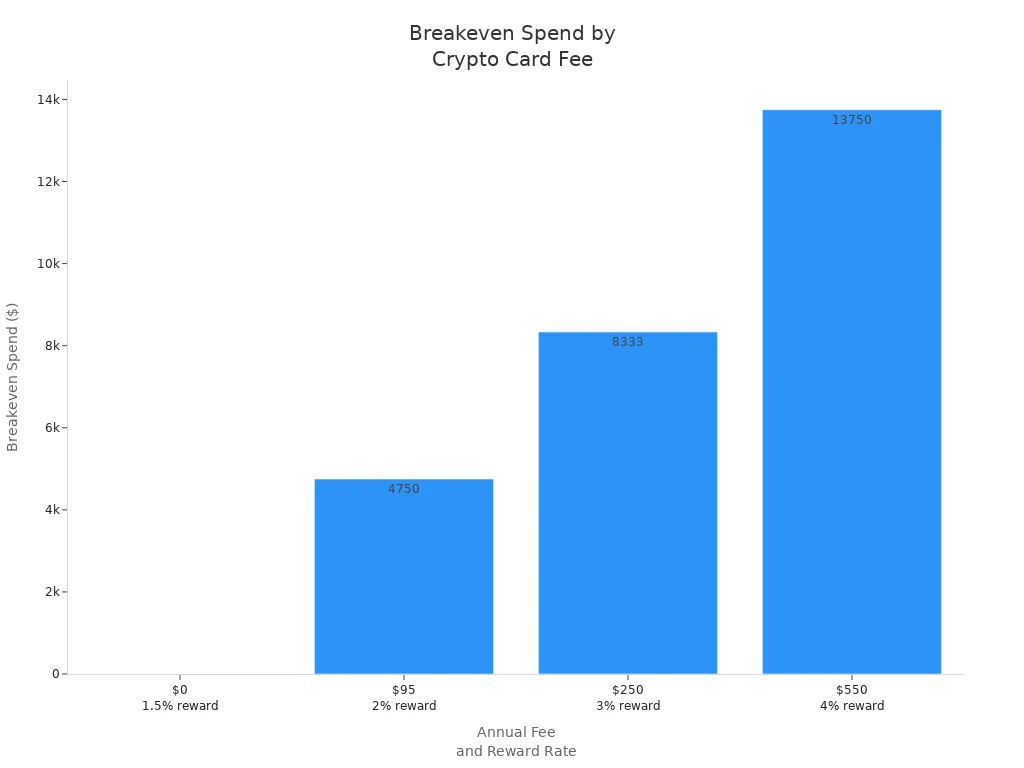
Hidden fees can make crypto card fees more expensive than expected. These include annual fees, high APRs, foreign transaction fees, and conversion spreads. Some cards require a minimum monthly spend to offset annual fees with rewards. For example, a card with a $95 annual fee and 2% crypto back requires you to spend $4,750 per year to break even.
Annual Fee | Reward Rate | Breakeven Spend | Monthly Spend Required |
|---|---|---|---|
$0 | 1.5% | $0 | $0 |
$95 | 2% | $4,750 | $396 |
$250 | 3% | $8,333 | $694 |
$550 | 4% | $13,750 | $1,146 |
APRs can reach up to 29.99%
Foreign transaction fees range from 1% to 3%
Crypto conversion spreads add 1% to 2.5% to purchases
If you spend $500 monthly on a card with a $95 fee and 2% rewards, you earn $120 in rewards but pay $95 upfront. Your net benefit is only $25, or an effective return of 0.4%. In contrast, a no-fee card with 1.5% rewards yields $90 with no cost. You should always read the provider’s fee disclosures and calculate your breakeven point before choosing a card.
Alert: Hidden fees can reduce your rewards and increase your costs. Always check the fine print and ask providers about all possible charges.
How Crypto Card Fees Are Calculated
Conversion Spread Examples
You pay conversion fees when you spend with a crypto card. Providers calculate these fees using the market value of your crypto and the exchange rate at the time of your transaction. The system checks your available balance and authorizes the payment based on the current value. For example, if you buy $100 in USD and the provider charges a 2% conversion fee, you pay $2 in fees. Some providers add a spread, which is the difference between the real market rate and the rate they offer you. If the market rate for Bitcoin is $40,000 and your provider uses $39,200, the 2% spread means you get less value for your crypto.
Tip: Always check the conversion rate before you spend. Even a small spread can increase your total crypto card fees over time.
ATM and Top-Up Fee Scenarios
ATM and top-up fees can add up quickly. UUPAY, for example, charges a 2% ATM withdrawal fee with a $1 minimum. If you withdraw $100, you pay $2. For a $30 withdrawal, you pay $1 because of the minimum. Top-up fees usually cost 1.5%. If you add $200 to your card, you pay $3 in fees. UUPAY also charges $0.10 for micro-transactions under $1 and $0.03 for 3DS verification.
Fee Type | Amount |
|---|---|
1.5% | |
Micro-transaction (<$1) | $0.10 / txn |
3DS Verification | $0.03 / txn |
ATM Withdrawal Fee | 2% (min $1) |
You should review these scenarios before using your card. This helps you avoid unexpected costs and manage your spending more effectively.
Why Fees Differ by Provider
Provider Models
You see differences in crypto card fees because each provider uses a unique business model. Some companies focus on rewards, while others prioritize low fees or strong compliance. Providers may partner with banks or payment networks, which affects their fee structure. For example, UUPAY offers a virtual card for only 1U and gives you 1U cashback when you activate it. You can also earn up to 50% commission through their referral program. These promotions help you save money and benefit from sharing the service with friends.
Card Network Impact
The card network plays a major role in fee dynamics. You may use cards issued through Visa, Mastercard, or American Express. Each network uses a different model:
Card Network Model | Description | Fee Dynamics |
|---|---|---|
4-Party Model (Visa & Mastercard) | Connects cardholder, issuer, acquirer, and network. | |
Closed-Loop Model (American Express) | Controls the full value chain, including issuing and acquiring. | Interchange fees can reach up to 3.3% on premium products. |
You pay higher fees with premium cards or closed-loop networks. You should check which network your provider uses before applying.
UUPAY Fee Transparency
UUPAY stands out for its transparent fee disclosure. You can easily find all costs, including conversion, withdrawal, and maintenance fees. UUPAY holds a US MSB license, registers in Hong Kong, and has a Swiss license. The company also applies for a Brazil license. You get peace of mind with their compliance checklist:
US MSB Licensed
PCIDSS Level 1 Certified
24/7 Global Support
Tip: Always review the compliance credentials and fee schedule before choosing a provider. You protect yourself from hidden costs and ensure your funds stay secure.
Tips to Minimize Crypto Card Fees
Choosing the Right Card
You can lower your costs by picking a card that matches your spending habits. Look for cards with low or no monthly maintenance fees. Some cards offer rewards that help offset expenses. UUPAY, for example, gives new users a virtual card for just 1U and returns 1U after activation. This means you start with no net cost. UUPAY also stands out for its strong compliance, holding a US MSB license and meeting global standards. When you compare cards, check for transparent fee schedules and clear terms.
Choose cards with low or no monthly fees
Select cards that offer rewards or cashback
Review the provider’s compliance and support
Smart Spending Strategies
You can avoid unnecessary charges by planning your spending. Use your crypto card for purchases in USD to skip foreign exchange fees. Track your ATM withdrawals and stay within any no-fee limits. Top up your card in larger amounts to reduce the impact of fixed fees. UUPAY users can also benefit from referral rewards, earning up to 50% commission by inviting friends.
Tip: Always check the transaction and conversion fees before making a purchase.
Monitoring for Hidden Costs
You should review your statements regularly to spot hidden fees. Watch for inactivity charges, card replacement costs, or extra conversion spreads. Some providers require a minimum spend to make rewards worthwhile. UUPAY makes it easy to see all fees upfront, so you can avoid surprises. If you notice unexpected charges, contact customer support right away.
Staying alert helps you keep crypto card fees under control and maximize your benefits.
You face conversion, transaction, ATM, and hidden fees when using a crypto card. Compare providers and choose cards with clear fee schedules. Monitor your spending and check for hidden costs. UUPAY offers strong compliance and rewards. Stay informed about fee changes to keep your expenses low.
FAQ
What is the typical conversion fee for U.S. crypto cards?
You usually pay between 1% and 2.5% for each crypto-to-USD conversion. Always check your provider’s rate before you spend.
How can you avoid hidden crypto card fees?
Review your card’s fee schedule. Track your spending. Choose providers like UUPAY that show all fees clearly.
Is UUPAY a compliant and safe provider?
Compliance Check | Status |
|---|---|
US MSB Licensed | ✅ Yes |
PCIDSS Level 1 Certified | ✅ Yes |
24/7 Global Support | ✅ Yes |
You get strong compliance and support with UUPAY.
See Also
Evaluating USDC Cards Against Top Cryptocurrency Payment Solutions
Comprehensive Overview of USDT Visa Cards for Daily Use
Purchasing Cryptocurrency Using Your Credit Card Made Easy
Assessing Top Cryptocurrency Cards for Daily Transactions
Top USDT Debit Cards for Seamless Cryptocurrency Transactions
