US legality of USDT virtual Visa cards: compliance guide
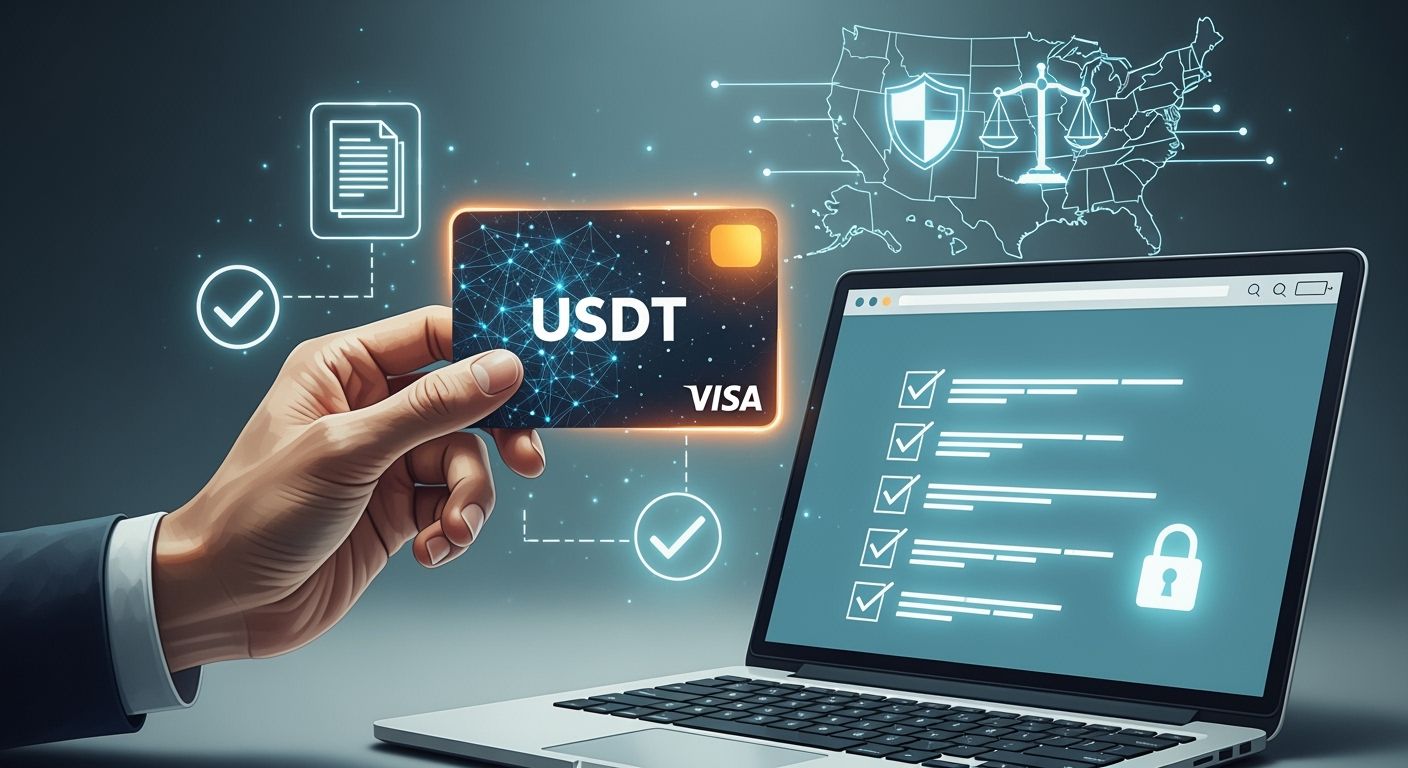
You may legally use USDT virtual Visa cards in the United States, but you must adhere to both federal and state rules regarding US legality. Visa’s requirements and new laws like the GENIUS Act shape the current environment. It is advisable to choose providers like UUPAY, which maintain strong compliance with US legality and international standards.
Key Takeaways
Understand federal and state laws for using USDT virtual Visa cards. Compliance with these laws protects you from legal issues.
Choose a provider like UUPAY that meets strict compliance standards. This ensures your transactions are secure and legal.
Keep detailed records of all USDT transactions for tax purposes. Report gains or losses to the IRS to avoid penalties.
US legality overview

When you use USDT virtual Visa cards in the United States, you must understand how US legality applies at both the federal and state levels. Visa’s requirements and the evolving regulatory landscape shape what is allowed and what is not. You need to know that the legal status of these cards depends on several factors, including how the provider manages compliance and which state you live in.
Federal law
At the federal level, USDT virtual Visa cards must comply with laws that regulate digital assets and payment systems. The federal government treats stablecoins like USDT as digital assets, and agencies such as the Financial Crimes Enforcement Network (FinCEN) and the Securities and Exchange Commission (SEC) monitor their use. You must use cards from providers that follow anti-money laundering (AML) and know your customer (KYC) rules. Visa also requires that all card issuers meet strict security and reporting standards.
You should know that federal law does not ban USDT virtual Visa cards. Instead, it sets rules to prevent illegal activities and protect consumers. Providers like UUPAY show their commitment to US legality by following these rules. For example, UUPAY appoints a compliance officer, follows the Travel Rule for digital asset transfers, and keeps detailed records for at least five years. The table below shows how UUPAY meets these federal compliance requirements:
Compliance Practice | Description |
|---|---|
Appointment of key officers | Designate a qualified compliance officer responsible for implementing and overseeing the AML/CFT program. |
Travel Rule compliance | Ensure that required information about digital asset transfers is collected, verified, and transmitted. |
Recordkeeping | Maintain detailed transaction and customer records for at least five years and make them available to regulators upon request. |
State law
State laws add another layer of complexity to US legality. Each state can set its own rules for digital assets and payment cards. Some states require special licenses for money transmitters, while others have stricter rules for virtual currencies. For example, New York has the BitLicense, which sets high standards for companies dealing with digital assets. If you live in a state with strict rules, you must check if your card provider holds the necessary licenses.
UUPAY addresses these challenges by holding a US Money Services Business (MSB) license and following state-specific requirements. This approach helps you use USDT virtual Visa cards with confidence, knowing that your provider respects both federal and state laws. UUPAY’s global compliance team monitors changes in regulations to keep your transactions safe and legal.
Tip: Always choose a provider that demonstrates strong compliance with both federal and state laws. This protects you from legal risks and ensures your funds remain secure.
By understanding how US legality works at both levels, you can make informed decisions and avoid potential problems when using USDT virtual Visa cards.
Regulatory framework
SEC and CFTC
You need to understand how the SEC and CFTC shape the compliance landscape for USDT virtual Visa card providers. These agencies focus on transparency and accurate representation. For example, USDT has faced scrutiny over how it reports its reserves. If you use a provider, you should check that it follows clear governance and avoids misrepresentation. New federal laws may soon add stricter requirements for issuers. Providers must register certain activities, such as securities offerings or futures trading, and may need special licenses. The table below shows some key compliance obligations:
Compliance Obligation | Description |
|---|---|
Registration of securities offerings | Required unless qualifying for an exemption. |
ATS license | Needed for platforms with secondary trading of securities. |
Investment Adviser registration | Necessary for firms managing security tokens. |
Qualified Custodian status | Required for custodians holding securities. |
FinCEN and FATF
FinCEN and the FATF set important standards for anti-money laundering and customer verification. You must use providers that follow strict KYC and AML rules. In the US, all money services businesses must run KYC programs, with no prepaid exemptions. If you use a USDT virtual Visa card, your transactions must meet these requirements. The FATF Travel Rule also applies. For transfers over $1,000, providers must share sender and receiver information. The table below summarizes these requirements:
Requirement | Description |
|---|---|
KYC Compliance | All MSBs must implement KYC programs. |
AML Compliance | Crypto card transactions must meet full AML/KYC standards. |
FATF Travel Rule | Sender and receiver info required for transfers over $1,000. |
Visa’s Click to Pay rules
Visa sets its own rules for crypto-linked cards. You should look for providers that hold legitimate financial licenses and follow global card scheme rules. Visa requires clear billing, so your transactions appear as standard Visa purchases. Asset security is also important. Some providers use institutional custody solutions to protect your funds until you spend them. These rules help maintain US legality and protect your interests.
Compliance Aspect | Description |
|---|---|
Channel Compliance | Issuers must have proper licenses and follow card scheme rules. |
Clear Billing | Transactions show as standard Visa purchases for easy recordkeeping. |
Asset Security | Funds are protected by institutional custody until you use them. |
Compliance requirements
AML/KYC
You must follow strict anti-money laundering (AML) and know your customer (KYC) rules when using or issuing USDT virtual Visa cards. These rules help prevent illegal activities and protect users. Issuers must create programs that meet the Bank Secrecy Act. They need to identify customers, monitor transactions, and keep records for five years. If you notice suspicious activity, issuers must file a report. The table below shows the main AML/KYC requirements:
Requirement Type | Description |
|---|---|
AML Program | Programs that meet Bank Secrecy Act standards, including risk monitoring. |
KYC Procedures | Customer identification and due diligence, especially for high-risk users. |
Record Keeping | Keep transaction and customer records for five years. |
SAR Filing | Report suspicious transactions to authorities. |
MSB Registration | Register as a Money Services Business with FinCEN. |
Licensing
You need to check if your provider holds the right licenses. Issuers must register as a Money Services Business with FinCEN and get money transmitter licenses in most states. Some states, like New York, require a BitLicense. Issuers must also secure a surety bond or funded account, usually starting at $500,000, and follow PCI DSS standards for cardholder data security. Many platforms work with sponsor banks that have Visa or Mastercard membership.
Register as a Money Services Business (MSB) with FinCEN.
Obtain state money transmitter licenses.
Secure a surety bond or funded account.
Comply with PCI DSS 4.0.1 for cardholder data.
Work with a sponsor bank for card issuance.
The Travel Rule
The Travel Rule requires issuers to collect and share sender and receiver information for digital asset transfers over $1,000. You must provide accurate details to meet this rule. This helps regulators track and prevent illegal transfers.
UUPAY stands out for its strong compliance. It holds a US MSB license, Hong Kong registration, and a Swiss license, and is applying for a Brazil license. UUPAY meets PCIDSS Level 1 standards, offers 24/7 global support, and provides user benefits like a new user virtual card offer, zero card recharge fees, and a referral commission program up to 50%. These features show UUPAY’s commitment to US legality and user protection.
Tax and reporting
IRS rules
You must treat USDT and other cryptocurrencies as property for tax purposes in the United States. The Internal Revenue Service (IRS) requires you to report gains or losses when you use, sell, or exchange USDT. If you use a USDT virtual Visa card to make purchases, you trigger a taxable event. The IRS expects you to calculate the difference between the value of USDT when you acquired it and its value when you spent it.
Note: The IRS does not consider USDT as cash. You must keep records of every transaction, including the date, amount, and value in US dollars.
Reporting USDT transactions
You need to report all USDT transactions on your annual tax return. This includes spending, exchanging, or converting USDT to other assets. Use IRS Form 8949 to list each transaction and Form 1040 Schedule D to summarize your gains or losses. Many users overlook small purchases, but the IRS can penalize you for failing to report.
Here is a simple checklist for reporting:
Track every USDT transaction.
Record the date, amount, and USD value.
Use Form 8949 and Schedule D for reporting.
Keep records for at least five years.
If you use a compliant provider like UUPAY, you can access transaction histories easily, which helps you stay organized for tax season.
Practical compliance steps
For individuals
You should follow a few simple steps to use USDT virtual Visa cards lawfully. First, choose a provider that meets US legality and holds the right licenses. Always complete identity verification (KYC) before activating your card. Track every transaction and keep records for your taxes. Report all gains or losses from USDT spending to the IRS. If you see suspicious activity, contact your provider right away.
Checklist for individuals:
Select a licensed and compliant provider
Complete KYC verification
Track and record all transactions
Report crypto gains or losses on your tax return
Monitor for suspicious activity
For businesses
If you issue or manage USDT virtual Visa cards, you must build strong compliance programs. Register as a Money Services Business with FinCEN. Obtain state licenses where required. Set up AML and KYC procedures for all users. Train your staff on compliance rules. Keep detailed records for at least five years. Review your compliance program often to match new regulations.
Business compliance steps:
Register as an MSB with FinCEN
Secure state money transmitter licenses
Implement AML/KYC programs
Train staff on compliance
Maintain records for five years
Using UUPAY
UUPAY makes compliance easy for you. The platform holds a US MSB license, meets PCIDSS Level 1 standards, and offers 24/7 global support. You can open a virtual card for only 1 USDT as a new user and get 1 USDT back. All users enjoy zero card recharge fees. UUPAY also rewards you for inviting friends, with commissions up to 50%. The company follows strict compliance in the US, Hong Kong, Switzerland, and is applying for a Brazil license. You can trust UUPAY to help you meet all legal and security requirements.
Tip: Choose UUPAY for a secure, compliant, and rewarding USDT card experience.
Risks and consequences

Non-compliance penalties
If you fail to follow USDT virtual Visa card regulations, you face serious penalties. US regulators can fine you, freeze your assets, or even bring criminal charges. For individuals, not reporting USDT transactions to the IRS can lead to audits and tax penalties. Businesses that skip AML/KYC checks risk losing their licenses and paying large fines.
Here is a summary of possible penalties:
Violation Type | Possible Penalty |
|---|---|
Tax evasion | Fines, interest, prosecution |
AML/KYC failure | License loss, heavy fines |
Unlicensed operation | Business shutdown, prosecution |
Note: You protect yourself by choosing a provider like UUPAY, which holds a US MSB license and meets strict compliance standards.
Regulatory challenges
You face ongoing regulatory changes in the US. Laws for digital assets shift quickly. Some states add new licensing rules or increase reporting requirements. You must stay alert to these updates. Businesses need to update compliance programs often. Individuals should check if their provider keeps up with new laws.
UUPAY helps you manage these challenges. The company holds licenses in the US, Hong Kong, and Switzerland, and applies for new ones in Brazil. UUPAY meets PCIDSS Level 1 standards and offers 24/7 support. You can trust UUPAY to keep your transactions safe and legal, even as rules change.
Tip: Always use a provider that adapts to new regulations and keeps your funds secure.
You ensure legal use of USDT virtual Visa cards by following US legality and Visa’s requirements. Choose a provider like UUPAY with strong compliance. For best results, check your country, use a dedicated email, and keep consistent name and address details.
Create a privacy-focused email
Use consistent name and address
FAQ
Can you use USDT virtual Visa cards in every US state?
You can use them in most states. Some states have stricter rules. Always check if your provider holds the right licenses for your state.
What makes UUPAY a compliant provider?
UUPAY holds a US MSB license, meets PCIDSS Level 1, and offers 24/7 support. You get strong compliance and security for your USDT virtual Visa card.
Are there any special offers for new UUPAY users?
You pay only 1 USDT to open a virtual card.
You get 1 USDT back after opening.
All users enjoy zero card recharge fees.
See Also
Comprehensive Overview of USDT Visa Cards for Daily Expenses
In-Depth Guide to Using USDT Cards for International Hotel Reservations
Thorough Guide on Utilizing USDT Cards for Payments in Thailand
Detailed Guide to USDT Visa Cards for Managing Daily Budgets
Discover the Advantages of USDT Cards for Effortless Transactions
